
Best AI Agent Registry Options for Enterprises in 2026
Compare enterprise AI agent registries for internal inventory, public discovery, Agent Cards, MCP servers, ownership and trust verification.

The best AI agent registry depends on what must be discovered. Use Entra, Okta or SailPoint for internal ownership and lifecycle. Use AGNTCY Directory for distributed capability discovery across agent systems. Use the Official MCP Registry for public MCP server metadata. Use A2A Agent Cards for direct service discovery. Concordium fits public owner and card-integrity anchoring. No registry entry should authorize a consequential enterprise action by itself.
This guide compares registry types through their first-party specifications and documentation. It is not a claim that every listed service has equivalent maturity, security or operating model.
Best AI agent registry by discovery scope
| Discovery scope | Best starting point | What it resolves | What it does not prove alone |
|---|---|---|---|
| Internal agent inventory | Entra Agent ID, Okta or SailPoint | Enterprise object, owner, lifecycle, access and audit context | External capability truth or exact transaction authority |
| Distributed agent capability discovery | AGNTCY Directory | OASF records, content-addressed metadata, capabilities and locators | That a described capability works safely in your environment |
| Public MCP server discovery | Official MCP Registry, preview | Namespace-verified server metadata, packages, endpoints and configuration | Package safety, runtime authorization or private-server inventory |
| Direct A2A service discovery | A2A Agent Card | Endpoint, capabilities, skills and authentication requirements | Independent owner verification unless extra evidence is supplied |
| Public identity and owner anchor | Concordium Agent Registry | Registry token, owner account, status and Agent Card hash | Enterprise employment, business permission or successful execution |
| Transaction trust lookup | OATI lookup, developer preview | Signed identity, mandate, status and service/profile records | A universal agent marketplace or generic capability ranking |
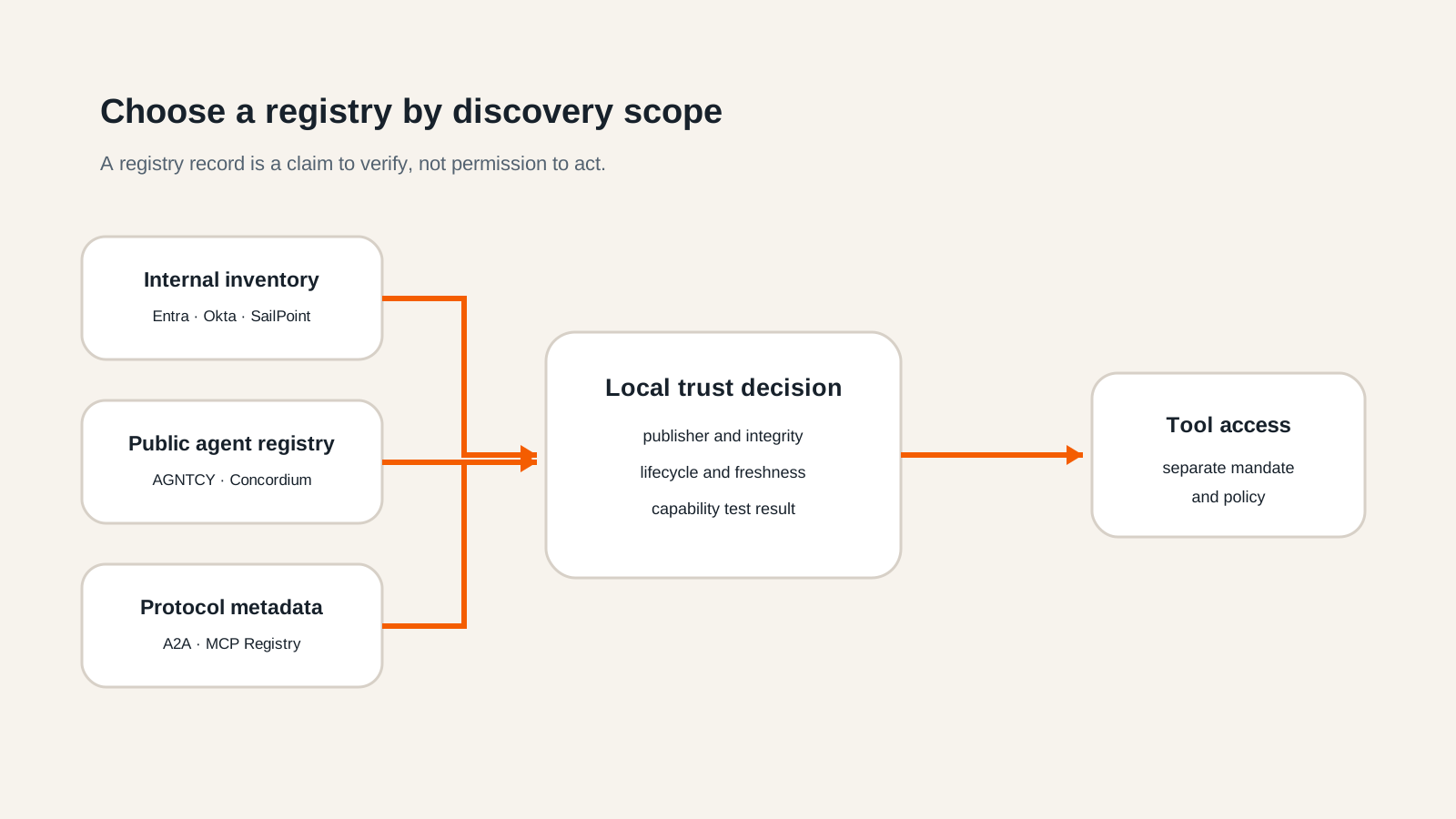
Swipe horizontally to inspect the full diagram.
AGNTCY Directory v1 documents content-addressed records, capability-based discovery, distributed lookup and SDKs. Its architecture reference explains records, OCI-backed storage and DHT indexes.
The Official MCP Registry is a preview metadata repository for publicly accessible MCP servers. It authenticates publisher namespaces but delegates code scanning to package registries and downstream aggregators. The documentation explicitly says it does not support private servers.
The A2A specification uses an Agent Card for direct or registry-based discovery of endpoints, skills and interaction requirements. Concordium adds a public registry token and committed Agent Card hash. Its registry reference describes the contract, indexer and MCP access.
Enterprise agent market positioning
Product-scope analysis, not market share, quality or maturity
Enterprise directories handle internal lifecycle. AGNTCY, A2A and MCP mechanisms handle capability discovery. Concordium provides a public owner and integrity anchor. Intelliger adds transaction authority and evidence after resolution. Coordinates show functional scope, not a league table.
Reviewed 17 August 2026. Read the positioning method and complete control-stack analysis.
Text summary of highlighted companies
| Company or protocol | Primary scope represented on the map |
|---|---|
| Intelliger | Transaction-specific authority, deterministic enforcement, reconciliation and portable evidence. |
| Concordium | Verified ownership, agent registry and identity-linked transaction infrastructure. |
| OriginTrail | Shared context graphs, provenance and decentralized knowledge infrastructure. |
| Okta for AI Agents | Agent identity, lifecycle, access and governance. |
| Microsoft Entra Agent ID | Enterprise agent identity, ownership, lifecycle and Microsoft ecosystem access. |
| AGNTCY | Open agent discovery, identity, messaging and observability infrastructure. |
Treat registry outputs as separate claims
Store each verification result separately:
type AgentRegistryFinding = {
  source: 'enterprise' | 'agntcy' | 'mcp' | 'a2a' | 'concordium' | 'oati';
  registryId: string;
  subject: string;
  publisherVerified: boolean;
  metadataIntegrity: 'valid' | 'invalid' | 'not_checked';
  lifecycle: 'active' | 'inactive' | 'unknown';
  capabilityClaims: string[];
  capabilityTests: string[];
  observedAt: string;
  expiresAt?: string;
};
publisherVerified says who could publish under a namespace or key. metadataIntegrity says whether the retrieved bytes match a commitment or signature. Neither field says the tool is safe, the endpoint is uncompromised or the enterprise granted authority.
Run a registry acceptance fixture
Publish one harmless lookup capability and one material write capability. Then test:
- Resolve the record by exact identity and by capability.
- Change the hosted metadata without updating its signature, hash or version.
- Revoke or deactivate the agent and measure cache propagation.
- Transfer ownership or change the accountable owner.
- Publish the same display name from an untrusted namespace.
- Advertise a capability the endpoint does not implement.
- Return a valid Agent Card whose endpoint certificate is wrong.
- Remove the registry or indexer and test the safe fallback.
- Present a valid record with an expired enterprise mandate.
- Attempt a material tool call through a route that never checks the registry.
Record registry version, trust roots, cache policy, namespace evidence, network availability and the local decision that followed resolution.
Failure cases and required response
| Failure | What may still be valid | Required response |
|---|---|---|
| Registry is unavailable | Cached metadata and its prior integrity result | Use only inside an explicit freshness policy or fail closed |
| Publisher namespace verifies but package is malicious | Publisher attribution | Run package and runtime security controls separately |
| Agent Card hash matches but capability is false | Card integrity | Test capability and retain result as a separate signal |
| Public status is active but local agent is revoked | Public record | Local enterprise revocation wins |
| Owner changes | Registry history | Reapprove local mapping and credentials |
| Two records use the same display name | Both names | Select by immutable identity and trusted namespace |
| Valid registry identity presents a broader mandate | Identity finding | Reject non-amplifying authority failure |
Where Intelliger is complementary
Intelliger should map records into established directories and registries, not build a universal directory. The intended flow resolves identity and capability metadata, maps the result to a local subject, checks a transaction-specific mandate, evaluates local policy and produces bounded action evidence after execution.
OATI currently has a developer-preview public lookup and private control-plane vertical slice for signed records, status and key lifecycle. Service and Profile records are deployed. AGNTCY, MCP Registry and Concordium production adapters, broad federation, hardened enforcement, durable evidence and independent review are incomplete.
Questions buyers ask
Is the Official MCP Registry suitable for private enterprise servers?
No. Its documentation says private servers are outside its scope. Operate a private registry or enterprise catalog and apply your own access and security controls.
Does an A2A Agent Card identify the legal owner?
It describes provider and service metadata. Legal-owner assurance requires an enterprise directory, verified credential, public registry or other trusted evidence selected by the relying party.
Should we put every internal agent on a public registry?
No. Publish only when cross-organization discovery justifies the privacy, metadata, key-management and operational costs.
Can a registry rank the safest agent?
Only with an explicit, evidence-backed scoring method. Namespace verification, uptime, capability tests, incident history and transaction authority are different findings and should remain separable.
Place registries inside the enterprise agent control stack, review the Concordium Agent Registry evaluation and compare identity with transaction authorization.
Expert review required before publication: an enterprise architect and agent-protocol specialist should verify registry status, namespace assumptions, privacy risks and cache behavior.
To inspect Intelliger's currently deployed record types, open the OATI lookup tools.