
Microsoft Entra Agent ID vs Okta for AI Agents
Compare Microsoft Entra Agent ID and Okta for AI Agents across identity, discovery, lifecycle, delegation and transaction authorization.

Microsoft Entra Agent ID is the more natural choice for organizations standardizing agent identity inside Microsoft Entra, Microsoft 365 and Agent 365. Okta for AI Agents is a strong candidate for heterogeneous SaaS estates that already use Okta for workforce identity and need agent discovery, registration and token exchange. Neither product should be treated as automatic approval for a specific refund, payment or production change.
This is a documentation-based product evaluation, not a hands-on performance benchmark. Product editions, preview labels and supported discovery sources can change. Recheck the linked vendor documentation during procurement.
Microsoft Entra Agent ID vs Okta for AI Agents in one table
| Evaluation question | Microsoft Entra Agent ID | Okta for AI Agents |
|---|---|---|
| Best fit | Microsoft-centered identity and productivity estate | Mixed SaaS estate with Okta as the identity control plane |
| Agent object | Agent identity created from a reusable blueprint | Registered AI agent with connections, owner and lifecycle |
| Accountability | Owners, sponsors and managers have distinct roles | Apps and owners link agent access to human accountability |
| Authentication | Entra tokens through agent blueprints and documented OAuth patterns | Public-key credentials and standardized token exchange |
| Discovery | Central Entra inventory and Microsoft product integrations | Browser OAuth signals plus managed application connectors |
| Broad access control | Entra roles, Graph permissions, Conditional Access and governance | Least-privilege connections, scopes, lifecycle and access governance |
| Exact transaction decision | Requires a separate business-policy check when API grants are too broad | Requires a separate business-policy check when connection grants are too broad |
| Current caveat | Features and licenses vary across Agent ID and Agent 365 | API documentation labels the current API beta; connector coverage varies |
Swipe horizontally to inspect the full diagram.
Microsoft documents an agent identity as a distinct service-principal type created from an agent identity blueprint. The identity has no credential of its own; the blueprint acquires tokens for it. Sponsors provide business accountability, while owners and managers have separate administrative roles. Microsoft's Agent ID concepts and agent identity overview describe this model.
Okta documents registration, lifecycle states, connections, public keys and token exchange for AI agents. Its Identity Security Posture Management service can also discover AI-related OAuth grants and agents in supported managed applications. Okta's AI Agents API model and ISPM discovery documentation support those claims. The API overview currently labels the APIs beta even though specific discovery capabilities have their own release status.
Enterprise agent market positioning
Product-scope analysis, not market share, quality or maturity
Entra and Okta occupy the enterprise identity and lifecycle region. Intelliger sits farther toward transaction authority and evidence, where the identity output becomes one input to an exact business-action decision.
Reviewed 17 August 2026. Read the positioning method and complete control-stack analysis.
Text summary of highlighted companies
| Company or protocol | Primary scope represented on the map |
|---|---|
| Intelliger | Transaction-specific authority, deterministic enforcement, reconciliation and portable evidence. |
| Concordium | Verified ownership, agent registry and identity-linked transaction infrastructure. |
| Okta for AI Agents | Agent identity, lifecycle, access and governance. |
| Microsoft Entra Agent ID | Enterprise agent identity, ownership, lifecycle and Microsoft ecosystem access. |
| SailPoint | Agent inventory, ownership, access review and entitlement governance. |
Choose based on the identity estate you must operate
Choose Entra when agents need to appear as native identities beside Microsoft users, applications and resources. Blueprints help apply one security model to many instances of the same agent type. Conditional Access, governance roles and Microsoft Graph permissions then reuse controls the identity team already understands.
Choose Okta when the enterprise already governs workforce and SaaS access through Okta and needs to find agent access that began as an OAuth grant. Okta's connection model and token exchange can preserve the relationship between a person, an agent and a downstream application without requiring every SaaS provider to adopt a new directory.
Do not choose on the number of controls printed on a product page. Run the same lifecycle and abuse fixture in both environments. Check the exact license, tenant type, agent framework, application connector and token flow involved.
Identity authorization still stops before many business decisions
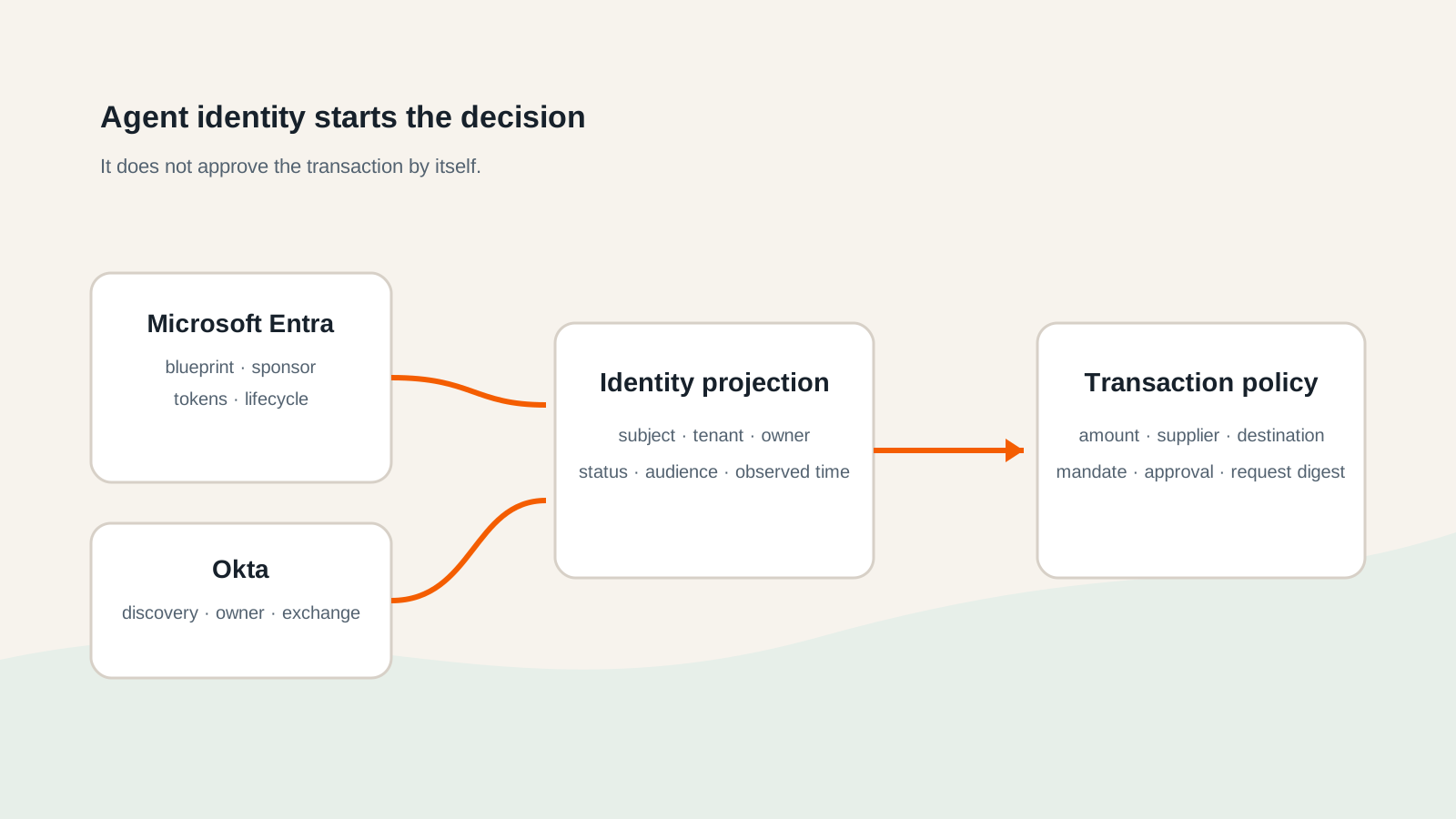
Both products authorize access. That matters. The remaining gap appears when an API permission covers a class of actions but the enterprise must decide one transaction.
An accounts-payable agent may have permission to call a payment API. The business decision can still depend on:
- supplier and bank-account status at the decision time;
- purchase-order and invoice binding;
- currency, amount and cumulative budget;
- separation of duties and an approval tied to this request digest;
- whether an earlier submission is accepted, unknown or settled.
Represent that handoff explicitly:
type AgentIdentityProjection = {
  tenantId: string;
  subject: string;
  identityProvider: 'entra' | 'okta';
  agentType: string;
  ownerRefs: string[];
  sponsorRef?: string;
  lifecycleStatus: 'active' | 'inactive' | 'unknown';
  tokenAudience: string;
  observedAt: string;
};

type PaymentTransaction = {
  transactionId: string;
  supplierId: string;
  invoiceId: string;
  amountMinor: number;
  currency: string;
  destinationDigest: string;
  requestDigest: string;
};
The identity projection answers who is acting and whether the identity is current. A mandate and policy decision answer what that identity may do. Do not infer supplier, amount or destination authority from group membership unless the policy explicitly defines that mapping.
Run the same identity proof of concept in both platforms
Create one agent that can read invoices and propose a payment. It must not submit payment until an independent decision returns allow.
- Register the agent and assign an accountable owner or sponsor.
- Issue the normal runtime credential without storing it in the model prompt.
- Confirm the receiving API validates issuer, audience, expiry and subject.
- Disable the agent and measure revocation propagation to every execution path.
- Change the owner or sponsor and inspect historical audit attribution.
- Attempt token exchange for an unapproved resource and require denial.
- Invoke the allowed API with a modified amount and require the transaction-policy layer to deny it.
- Attempt the same action through a direct network path that bypasses the policy point.
- Export the records needed to explain identity, authority, approval and provider outcome.
Record product edition, configuration, timestamps and every manual step. A comparison that tests only successful sign-in says little about agent governance.
Failure cases that expose the boundary
| Failure injection | Identity-platform expectation | Transaction-control expectation |
|---|---|---|
| Agent disabled during a cached session | token or session stops within the documented freshness window | material action denies when identity status is stale |
| Valid identity presents another tenant's mandate | authentication succeeds | tenant binding fails |
| Agent has API write scope but amount exceeds budget | access may remain valid | deterministic amount or budget rule denies |
| Human approval belongs to another request digest | identity and approver may be valid | approval binding fails |
| Blueprint or connection permission expands | change appears in governance and audit | existing mandate does not silently expand |
| Direct credential reaches the provider | identity may still be valid | network and credential controls expose or prevent bypass |
| Provider times out after submission | identity record remains unchanged | transaction stays unknown pending reconciliation |
Where Intelliger is complementary
Intelliger should consume Entra or Okta identity rather than create a competing enterprise directory. The intended integration maps the verified subject, tenant, owner, sponsor, credential method and lifecycle status into a canonical transaction envelope. OATI then binds a portable mandate, policy decision and approval to the request digest.
The gateway can release a short-lived provider credential after the decision, keep proof replay separate from business idempotency and issue a bounded receipt after execution. Entra or Okta remains authoritative for identity. The business system remains authoritative for payment, refund or production state.
Questions buyers ask
Does Entra Agent ID replace Okta for AI Agents?
Not universally. Entra fits naturally where Microsoft identity and Agent 365 are strategic. Okta fits naturally where Okta already governs a mixed SaaS estate. Migration cost, supported applications and the required agent token flow matter more than a generic feature count.
Can either platform authorize a payment?
Either platform can control access to a payment application or API. A payment still needs transaction-specific business policy when permission depends on supplier, amount, destination, budget, approval and prior execution state.
Should an enterprise register the same agent twice?
Avoid two competing lifecycle records. Choose one authoritative enterprise identity and map it into other systems. Preserve immutable identifiers and status timestamps so downstream controls can detect stale or ambiguous mappings.
Does a sponsor make the agent safe?
A sponsor establishes accountable ownership. It does not validate every action the agent proposes. Runtime authorization, controlled execution and reconciliation still matter.
Current Intelliger and OATI boundary
OATI's public developer preview implements schemas, canonical signing, verification, deterministic mandate evaluation, replay checks, receipts and a 73-case cross-language conformance suite. A hosted trust and lookup slice is deployed, and a reference Envoy authorization path exists.
The commercial identity adapters, hardened gateway fleet, complete policy compiler, durable evidence service, independent protocol review and production acceptance are incomplete. Intelliger should therefore be evaluated as a complementary developer-preview transaction-control layer, not a replacement for production Entra or Okta identity operations.
Use the broad AI agent identity versus authorization guide for the control model, the enterprise agent control stack for ownership boundaries and the AI agent authorization guide for implementation mechanics.
Expert review required before publication: an enterprise identity architect should verify licensing assumptions, current release labels, token flows and the comparison fixture.
To map one identity flow into a bounded transaction, review the Agent Trust architecture and contact Intelliger.