
Best AI Agent Payment Platforms and Controls in 2026
Compare AI agent payment platforms, wallets, tokens and protocols across rails, spending policy, approval, settlement and evidence.


There is no single best AI agent payment platform because the candidates solve different layers. Circle Agent Stack is a strong fit for USDC wallets and x402 services. Stripe is a strong fit for merchant card acceptance and scoped shared payment tokens, currently in private preview. Coinbase x402 fits HTTP-native onchain API payments. Catena targets agent financial operations across accounts, policy and payment services. Google AP2 is an open mandate protocol, not a payment provider. Enterprises still need an independent control for exact approval, duplicate prevention, reconciliation and evidence.
This is a documentation review, not financial advice or a hands-on settlement benchmark. Availability, geography, licensing and regulated roles require direct legal and provider review.
Best AI agent payment platforms by payment job
| Payment job | Best starting point | Documented capability | Boundary to test |
|---|---|---|---|
| Onchain agent wallet and USDC spending | Circle Agent Stack | Agent Wallets, custom spending policies, multichain operations and x402 support | Confirm custody model, chain support, sanctions controls and recovery for your market |
| Card-based merchant checkout through agents | Stripe agentic commerce | Transaction-scoped, time-limited shared payment tokens and merchant payment processing | Agentic commerce and shared payment tokens are labeled private preview |
| Paid APIs over HTTP | Coinbase x402 | HTTP 402 challenge, signed payment payload, facilitators and SDKs | Wallet, token, network and facilitator risk remain explicit dependencies |
| Broader agent finance operations | Catena | Vendor-documented accounts, financial policy, approvals and payment integrations | Its terms say Catena is not a bank, custodian or money-services business |
| Portable payment intent and mandate | Google AP2 | Typed intent, cart and payment mandates for human-present and delegated flows | AP2 does not settle funds or replace provider compliance |
| Cross-rail transaction control | Intelliger and OATI, developer preview | Exact transaction binding, mandate limits, decision, execution state and receipt | Commercial payment connectors and production acceptance are incomplete |
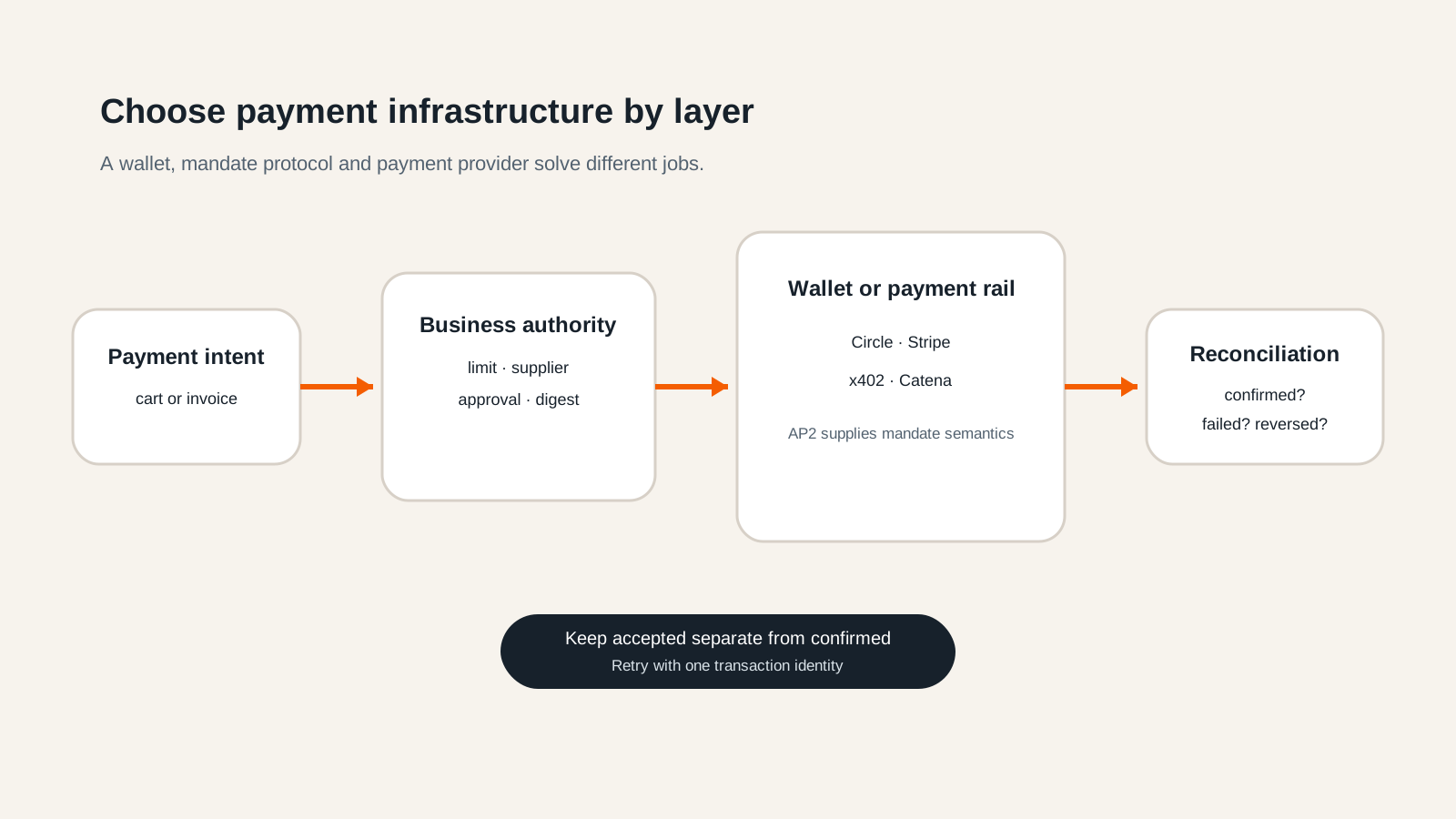
Swipe horizontally to inspect the full diagram.
Circle documents Agent Stack as tooling for wallets, USDC transactions, x402 services and configurable spending controls. Stripe's agentic commerce documentation describes SharedPaymentToken objects that pass payment credentials and risk signals without exposing underlying credentials. It currently labels the feature private preview.
Coinbase documents x402 as an open HTTP payment protocol in which a server returns payment requirements, the client provides a signed payload and a facilitator verifies and settles. Catena's terms of service make the provider boundary unusually clear: financial services come from service providers, while Catena itself is not a bank or custodian.
Google's AP2 specification defines mandates and flow semantics. Treat it as a protocol profile that can sit above several rails, not as a substitute for a licensed payment provider.
Enterprise agent market positioning
Product-scope analysis, not market share, quality or maturity
Circle and x402 sit close to wallets and settlement. AP2 and UCP define commerce and mandate interactions. Catena covers a broader financial control plane. Intelliger is positioned around provider-neutral transaction authority, reconciliation and evidence. Coordinates show scope, not maturity.
Reviewed 17 August 2026. Read the positioning method and complete control-stack analysis.
Text summary of highlighted companies
| Company or protocol | Primary scope represented on the map |
|---|---|
| Intelliger | Transaction-specific authority, deterministic enforcement, reconciliation and portable evidence. |
| Catena | Agent financial policy, approvals, accounts, payment execution and audit. |
| Circle Agent Stack | Programmable wallets, USDC settlement and x402 support. |
| Google AP2 | Typed checkout and payment mandates, role validation and receipts. |
| UCP | Commerce discovery, checkout, payment-handler and order-lifecycle protocol. |
Separate five payment layers before selecting a vendor
A buyer should label each component in the proposed architecture:
- Intent and checkout describe what the buyer wants.
- Business authority constrains who may pay, how much, to whom and why.
- Credential or wallet control protects the means of payment.
- The provider or facilitator executes and reports status.
- Reconciliation establishes the business outcome and handles ambiguity.
Represent the handoff with one stable record:
type AgentPaymentRequest = {
  transactionId: string;
  payerTenant: string;
  supplierId: string;
  invoiceId?: string;
  amountMinor: number;
  currency: string;
  destinationDigest: string;
  mandateRef: string;
  approvalRef?: string;
  requestDigest: string;
  provider: 'circle' | 'stripe' | 'x402' | 'catena' | 'other';
  providerIdempotencyKey: string;
};

type PaymentOutcome =
  | { state: 'not_submitted' }
  | { state: 'accepted' | 'unknown'; providerRef: string }
  | {
      state: 'confirmed' | 'failed' | 'reversed';
      providerRef: string;
      observedAt: string;
    };
Do not map an HTTP success directly to confirmed. An accepted transfer, blockchain submission or checkout response can still require settlement or business reconciliation.
Run one cross-platform payment fixture
Use a small test payment and the same controls across candidates:
- Bind supplier, destination, currency and amount into
requestDigest. - Require a mandate with a per-transaction and cumulative limit.
- Require independent approval for one test threshold.
- Release the wallet or provider credential only after the decision.
- Submit twice with the same provider idempotency key.
- Retry after a simulated timeout without changing the transaction identity.
- Change one destination byte after approval and require denial.
- Revoke the agent before credential release and require denial.
- Reconcile accepted, unknown, confirmed, failed and reversed states.
- Export an evidence package that a controller can verify without model traces.
The fixture should record fees, finality, region, provider terms, wallet recovery, policy freshness, retry behavior and the human steps required to resolve an unknown outcome.
Failure cases a product demo should include
| Failure | Unsafe shortcut | Required response |
|---|---|---|
| Provider times out after submission | Submit a new payment with a new identifier | Query by the original idempotency key and keep state unknown |
| Agent changes destination after approval | Reuse approval because amount is unchanged | Reject the digest mismatch |
| Wallet policy allows but enterprise budget is exhausted | Treat wallet policy as the full business mandate | Deny before credential release |
| Payment confirms but order creation fails | Mark commerce journey complete | Reconcile payment and order, then compensate or escalate |
| Chain or facilitator is unavailable | Switch rail without new policy | Require an authorized fallback profile |
| Receipt is signed | Assume no bypass occurred | Verify issuer attestation, architecture and provider evidence separately |
Where Intelliger is complementary
Intelliger should not become a bank, wallet, custodian, facilitator or card processor. Its intended role is to normalize the transaction above the selected rail, enforce non-amplifying authority, bind any approval, release credentials through a controlled adapter and reconcile the provider result.
OATI's current developer preview implements schemas, canonical signatures, mandate evaluation, replay controls, receipts and cross-language conformance. The fiat and wallet production connectors, hardened gateway, durable reconciliation and dispute service, independent review and production acceptance are incomplete. The broader agent-commerce payment platform remains target architecture.
Questions buyers ask
Is a wallet spending limit enough?
It is useful but narrower than business authorization. A controller may also need supplier, invoice, purpose, destination, approval, cumulative budget and separation-of-duties rules.
Is x402 a payment platform or protocol?
x402 is an open protocol with reference SDKs and facilitator services. The chosen wallet, network, token and facilitator form the operational payment stack.
Does AP2 compete with Stripe or Circle?
Not directly. AP2 standardizes intent and mandate objects. Stripe or Circle can provide payment credentials, wallet operations, processing or settlement beneath a compatible flow.
Can an LLM approve a payment?
An LLM can extract fields, explain an exception or recommend an action. Deterministic policy and an authorized human or system should make the material approval decision.
Use the agentic payments control guide, compare the AP2, x402 and UCP payment stack and review Catena versus Circle Agent Stack.
Expert review required before publication: payments counsel, a finance controller and a security architect should verify regulated roles, provider status, geographic availability and recovery semantics.
To discuss one provider-neutral payment control fixture, contact Intelliger.