
Catena vs Circle Agent Stack for Enterprise Agent Payments
Compare Catena and Circle Agent Stack across agent accounts, wallets, spending policies, stablecoins, compliance, settlement and evidence.

Choose Catena when the buyer wants a business-facing governance and banking layer for AI agents, including identity, policies and access to financial services through providers. Choose Circle Agent Stack when the engineering task is to give an agent a user-controlled onchain wallet, USDC payment capability, x402 access and explicit wallet-level spending policies. They are adjacent products, not direct substitutes in every deployment.
This comparison is technical information, not financial, legal or regulatory advice. Verify availability, jurisdictions, service-provider terms, custody, screening and transaction limits directly with each vendor.
Catena vs Circle Agent Stack in one table
| Evaluation area | Catena | Circle Agent Stack |
|---|---|---|
| Primary proposition | Governance and banking platform for AI agents | Agent-native wallet, stablecoin and service-payment tooling |
| Financial role | Software and access to financial services supplied by service providers | Circle wallet and blockchain infrastructure |
| Agent control | Identity, policies, organization account and agent finance workflow | Per-transaction and rolling USDC limits plus recipient or contract lists |
| Assets and rails | Product materials describe accounts, payments and provider access | USDC, EURC, supported tokens, multichain transfers, CCTP and x402 |
| Custody statement | Catena terms say Catena is not a bank, custodian, MSB or regulated financial provider | Agent Wallet docs describe user-controlled 2-of-2 MPC wallets and user custody |
| Compliance | Catena terms and product describe provider, eligibility and policy controls | Agent Wallet transfers receive sanctions screening; additional Compliance Engine has eligibility requirements |
| Developer entry | Dashboard, APIs, CLI/MCP references and open Agent Commerce Kit patterns | Circle CLI, Agent Wallets, Agent Nanopayments and open skills |
| Best fit | Enterprise finance team seeking agent-account governance across a business workflow | Developer seeking direct onchain wallet operations and stablecoin payment primitives |
| Remaining enterprise control | Exact invoice or order authority, approval binding and cross-provider reconciliation must be verified | Exact invoice or order authority, approval binding and offchain business reconciliation must be added |
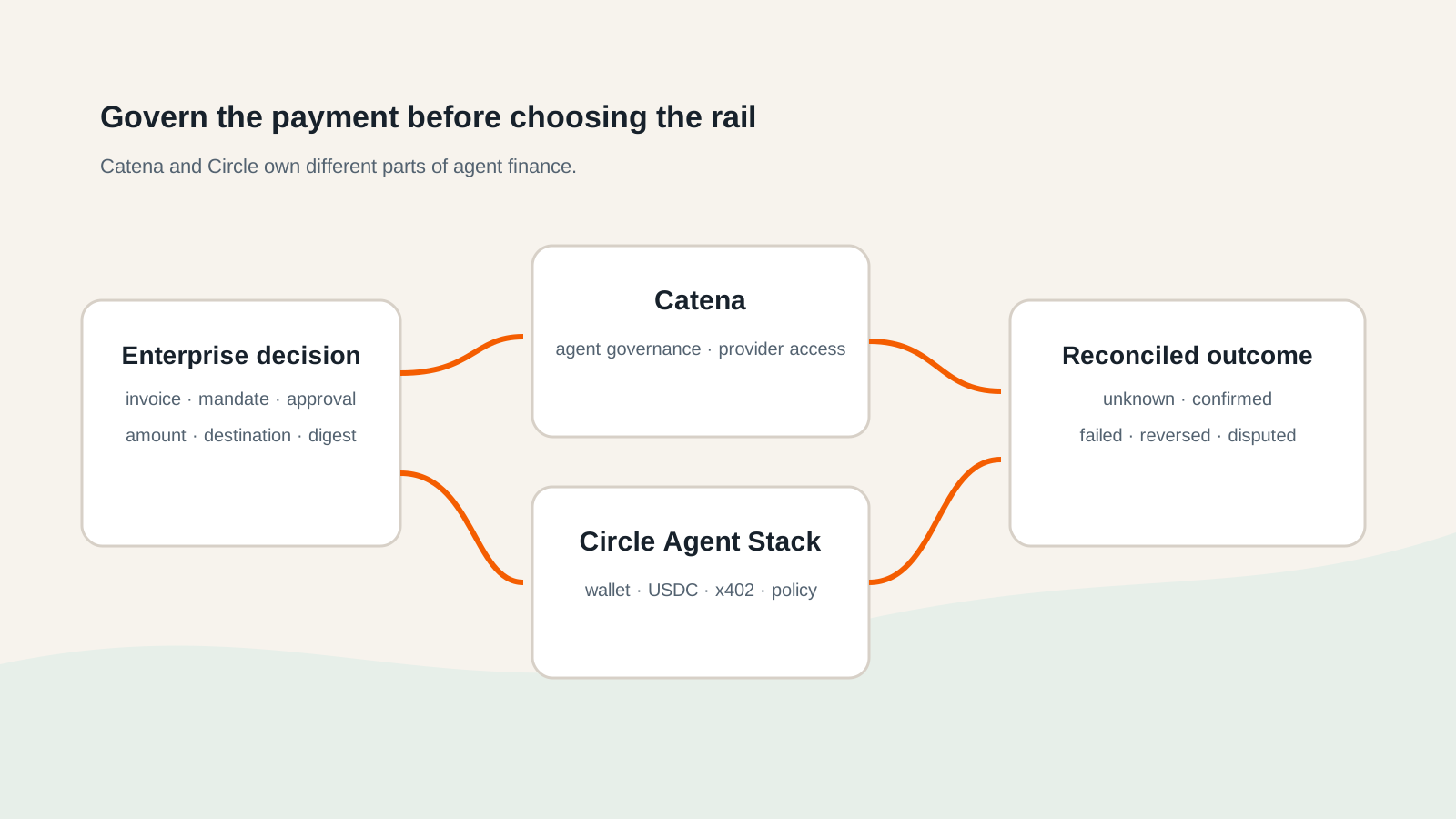
Swipe horizontally to inspect the full diagram.
Catena's current terms say its services include identity, policy, governance, controls and access to digital-asset wallets and financial services from service providers. The same terms explicitly say Catena is not a bank, custodian, money transmitter or other regulated financial-service provider. That distinction belongs in the architecture and procurement review.
Circle's Agent Wallet documentation describes user-controlled wallets with 2-of-2 MPC, agent operation inside spending policies and sanctions screening. The spending-policy guide documents per-transaction, daily, weekly and monthly USDC limits plus recipient and contract allowlists or blocklists. Those custom policies currently require mainnet wallets.
Enterprise agent market positioning
Product-scope analysis, not market share, quality or maturity
Catena reaches business-facing agent finance and provider access. Circle reaches wallet and stablecoin execution. Intelliger is positioned above payment rails as a provider-neutral authority, reconciliation and evidence layer.
Reviewed 17 August 2026. Read the positioning method and complete control-stack analysis.
Text summary of highlighted companies
| Company or protocol | Primary scope represented on the map |
|---|---|
| Intelliger | Transaction-specific authority, deterministic enforcement, reconciliation and portable evidence. |
| Catena | Agent financial policy, approvals, accounts, payment execution and audit. |
| Circle Agent Stack | Programmable wallets, USDC settlement and x402 support. |
| Google AP2 | Typed checkout and payment mandates, role validation and receipts. |
| UCP | Commerce discovery, checkout, payment-handler and order-lifecycle protocol. |
Catena covers more of the business-facing finance experience
Catena presents an organization account where a business can credential agents, create financial relationships and set policies. Its open Agent Commerce Kit describes identity and payment patterns, while the commercial service gives those ideas an operating surface.
That breadth is useful if finance wants one place to govern several agents. The buyer must still identify which service provider holds assets, moves money or performs regulated functions. Contract, geography and provider dependency are part of the product, not footnotes.
Catena's closed ACK-Lab developer preview should not be confused with current commercial availability. The ACK-Lab notice says the hosted preview closed while the underlying protocol patterns remain open.
Circle covers more of the wallet and stablecoin execution path
Circle gives developers concrete wallet operations: create and fund a wallet, transfer, bridge, swap, execute contracts, sign typed data and pay x402 services. The agent uses Circle CLI while key shares remain outside the agent.
The controls are specific enough to test. A mainnet policy can cap USDC transfers for rolling periods or restrict destinations. Circle documents a second email OTP for policy changes. The Agent Wallet quickstart also warns that an agent with access to the session email can authenticate and perform wallet operations, which makes mailbox access part of the threat model.
Wallet limits still do not express the whole invoice or procurement decision. A destination allowlist does not prove that invoice 381 belongs to purchase order 72, that goods arrived or that this request has an independent approval.
Model the enterprise transaction above the wallet
Keep the business object independent from the selected provider:
type AgentPaymentTransaction = {
  transactionId: string;
  tenantId: string;
  agentSubject: string;
  mandateRef: string;
  invoiceId: string;
  purchaseOrderId: string;
  supplierId: string;
  amountMinor: number;
  currency: string;
  destinationDigest: string;
  approvalDigest: string;
  requestDigest: string;
  idempotencyKey: string;
};

type PaymentOutcome =
  | { state: 'proposed' | 'authorized' }
  | { state: 'submitted' | 'unknown'; providerRef: string }
  | {
      state: 'confirmed' | 'failed' | 'reversed' | 'disputed';
      providerRef: string;
    };
The Catena or Circle adapter maps this object to its own account, wallet and provider fields. Store the raw provider response and mapping version. Do not let the agent translate an ambiguous timeout into failure and submit a second payment.
Run a provider-neutral payment evaluation
Use the same supplier-invoice fixture with each platform:
- Create one agent identity and an accountable human owner.
- Set a per-transaction limit and a cumulative daily budget.
- Restrict the destination to one supplier-controlled account or wallet.
- Submit a valid test payment and retain the stable provider reference.
- Change the destination after approval and require denial.
- Split one budget across concurrent payments and test atomic enforcement.
- Time out after submission, then reconcile before retrying.
- Revoke the agent while it holds a live session.
- Change the policy and inspect the independent approval path and audit event.
- Export the evidence a controller would need to match invoice, authority, provider execution and final settlement.
Run small-value mainnet tests only when legal, security and finance owners approve them. Testnet behavior cannot establish production screening, policy or settlement behavior.
Failure cases expose different product boundaries
| Failure | Control to verify |
|---|---|
| Agent can access the policy-change email | separate approval and mailbox controls prevent self-expansion |
| Wallet destination is allowed but invoice is fraudulent | business mandate and invoice controls deny before wallet signing |
| Provider is unavailable after submission | state remains unknown until provider reconciliation |
| Daily budget is consumed concurrently | atomic reservation prevents overspend |
| Service provider changes or suspends access | dependency and recovery procedure are documented |
| Sanctions screening blocks a transfer | denial reason and manual-review path remain available |
| Payment confirms but delivery fails | payment and fulfilment outcomes remain separate |
| Receipt signature verifies without provider evidence | integrity passes; settlement remains uncorroborated |
Where Intelliger is complementary
Intelliger should remain non-custodial and provider-neutral. It can consume a Catena agent/account reference or Circle wallet address, evaluate a portable mandate and enterprise policy, bind approval to the exact request and release the provider credential only after authorization.
After submission, the outcome ledger can preserve accepted, unknown, confirmed, failed, reversed and disputed states across providers. A receipt can attest to the decision and captured provider reference without claiming that a signature independently proves settlement.
Catena is closer to Intelliger's Agent Spend Control concept because it combines business-facing governance and finance. Circle is a likely execution provider or integration because it exposes wallet primitives. Intelliger's differentiated claim must be the cross-provider transaction chain, not ownership of the payment rail.
Questions finance and engineering teams ask
Is Catena a bank?
Catena's current terms say no. They describe Catena as software and technology infrastructure that provides access to financial services through service providers. Procurement must identify those providers and their applicable terms.
Does Circle Agent Stack give custody to the AI agent?
Circle describes Agent Wallets as user-controlled wallets with 2-of-2 MPC. Key shares are not exposed to the agent, and the user retains custody. The agent can operate the wallet within configured policies and its authenticated session.
Which platform is better for fiat supplier payments?
That depends on the available Catena service providers and the enterprise's existing payment provider. Circle Agent Stack is centered on onchain wallets and stablecoins. A provider-neutral control layer can preserve the same authority and reconciliation model across both onchain and offchain rails.
Do wallet spending limits replace invoice approval?
No. Limits constrain value and destinations. Invoice approval can also depend on supplier, purchase order, delivery, duplicate detection, separation of duties and an exact request digest.
Current Intelliger and OATI boundary
OATI currently implements developer-preview identity, mandate, transaction, decision and receipt objects with deterministic evaluation, signing, verification, replay controls and cross-language conformance tests. The sandbox includes commerce and paid-API development flows.
Intelliger does not operate a wallet, payment rail, licensed financial service, commercial reconciliation product or deployed Agent Spend Control service. The complete policy compiler, evidence and dispute workflows, independent review and production acceptance remain open.
Use the agent payment stack comparison for protocol placement, the agentic payments guide for the decision boundary and the exactly-once payment article for retry and reconciliation design.
Expert review required before publication: payments, compliance and legal reviewers must verify current product terms, jurisdictions, custody, provider roles and the mainnet test plan.
To explore provider-neutral payment authority in a sandbox, open the OATI developer documentation.