
Kong Agent Gateway vs Portkey Agent Gateway
Compare Kong and Portkey for MCP, A2A, model routing, authentication, tool controls, observability and enterprise transaction authorization.

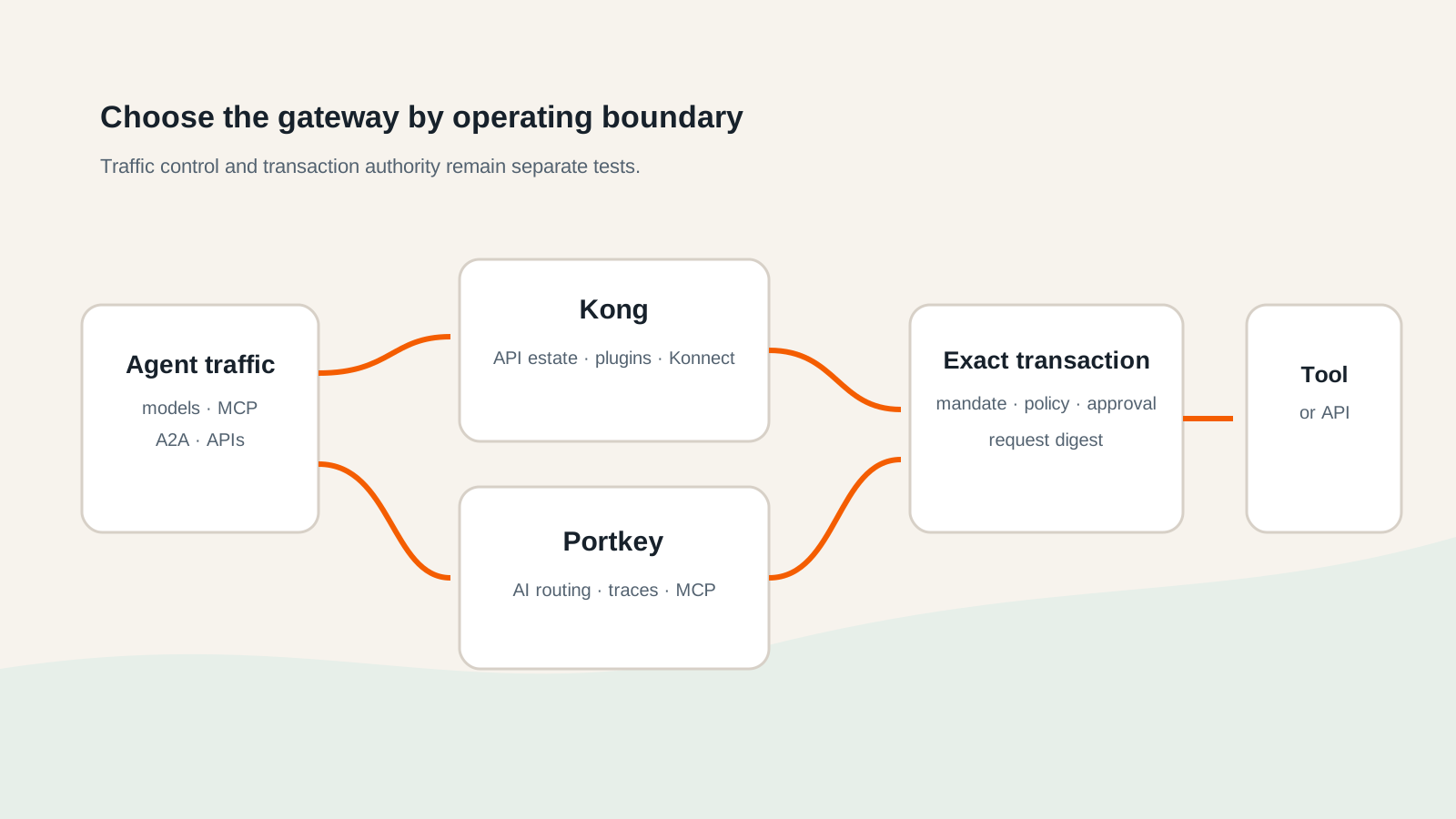
Choose Kong when the enterprise wants MCP and A2A controls inside an established API-gateway estate with declarative configuration, enterprise plugins and existing traffic operations. Choose Portkey when the team wants model routing, agent traces and managed MCP access in one AI-focused control surface. Test the exact edition and feature status because the two products overlap but do not expose identical controls.
Neither gateway automatically authorizes the business meaning of a refund, payment or production change. Both can enforce an external transaction decision.
Kong Agent Gateway vs Portkey Agent Gateway by responsibility
| Evaluation area | Kong | Portkey |
|---|---|---|
| Natural buyer | API platform and infrastructure team | AI platform and application team |
| Existing strength | General API gateway, plugins, Konnect and declarative operations | Model gateway, routing, guardrails and AI observability |
| MCP | Protocol-aware proxy, OAuth, ACLs, tool conversion, logs and metrics | Managed or self-hosted MCP proxy, registry, authentication, credential injection and logs |
| A2A | Protocol-aware proxy, card rewriting, structured traces and gateway controls | Agent Gateway beta describes governed endpoints, registry, access and full agent traces |
| Identity | Reuses Kong authentication plugins and maps identities to consumers | API keys, Portkey OAuth or external IdP validation |
| Upstream credentials | Pass-through or token-swap patterns, vault references and plugins | Per-user OAuth, client credentials or managed headers |
| Tool authorization | MCP ACL rules can allow or deny specific tools | Tool provisioning is documented; claim-based tool authorization is marked future in the authorization reference |
| Deployment | Kong Gateway and Konnect topologies depend on plugin and license | Fully managed, cloud deployment or self-hosted options are advertised |
| Business transaction policy | External decision or custom policy integration required for exact business semantics | External decision or custom policy integration required for exact business semantics |
Swipe horizontally to inspect the full diagram.
Kong's current documentation places its MCP and A2A features in Kong Gateway 3.14. The AI MCP Proxy plugin documents per-tool ACL behavior, while the A2A proxy documentation describes protocol parsing, card rewriting and observability. Several capabilities require Kong AI Gateway Enterprise or Konnect, so confirm topology and licensing.
Portkey's MCP Gateway overview describes centralized authentication, access control, credential injection and request logging. Its Agent Gateway announcement labels that broader product beta and describes registry, policy, routing and traces. The separate authorization page currently lists workspace and server control as available and tool-level control as coming soon. Treat tool provisioning and per-call claim authorization as distinct capabilities and verify both in the proposed edition.
Enterprise agent market positioning
Product-scope analysis, not market share, quality or maturity
Kong and Portkey both sit at the traffic and enforcement boundary. Intelliger is positioned as the transaction authority and evidence service that can supply a decision to either gateway rather than replacing its routing and protocol operations.
Reviewed 17 August 2026. Read the positioning method and complete control-stack analysis.
Text summary of highlighted companies
| Company or protocol | Primary scope represented on the map |
|---|---|
| Intelliger | Transaction-specific authority, deterministic enforcement, reconciliation and portable evidence. |
| Kong | LLM, MCP and A2A traffic gateway, authentication and observability. |
| Portkey | AI and MCP gateway, credential isolation, observability and guardrails. |
| Cloudflare | Distributed traffic, security, remote MCP and AI gateway infrastructure. |
| MuleSoft | Enterprise API integration, orchestration and agent-facing connectivity. |
Kong is stronger when gateway operations already exist
Kong lets a platform team extend familiar gateway practices to agent traffic. Standard authentication plugins can protect an A2A route. MCP-specific plugins parse calls, expose metrics and enforce ACLs. Declarative configuration and existing rollout procedures can matter more than an AI-specific dashboard when hundreds of APIs already use Kong.
The tradeoff is product and topology complexity. A feature may exist only in a particular version, enterprise package, Konnect deployment or plugin scope. A proof of concept must match the production topology rather than a convenient hosted tutorial.
Portkey is stronger when model and tool operations belong together
Portkey combines model routing, fallbacks, budgets, guardrails and AI traces with MCP access. Its authentication documentation separates the agent-to-Portkey identity from the Portkey-to-server credential. That is useful when developers should use tools without receiving GitHub, Slack or internal API credentials.
Portkey's observability can correlate model and tool calls. That is operationally useful, but logging full parameters and responses can also capture secrets, personal data or regulated records. Test redaction, regional storage, retention and export before sending production payloads through the gateway.
September source check and procurement acceptance record
Source check: 27 September 2026. Kong's secure internal MCP recipe specifies Gateway 3.14 or later and Konnect, and marks this recipe incompatible with on-prem. This is a recipe constraint, not a conclusion about all Kong deployments. Confirm your intended topology before reusing the example.
Portkey's authorization reference still marks claim-based tool authorization and authorization webhooks as future functionality. Tool provisioning and per-request claim authorization are different controls; a tool can be enabled for a workspace without enforcing your exact transaction conditions. The documentation also identifies Portkey as PRISMA AIRS AI Gateway. Keep the established comparison URL, but verify current product naming, edition and commercial terms during procurement.
| Acceptance item | Record for each candidate |
|---|---|
| Deployment | Product, edition, version, topology and enabled plugins |
| Identity | Actual issuer, resource audience and test principal |
| Tool restriction | Configuration and observed denied upstream call count |
| Business request binding | Component responsible for exact argument and approval checks |
| Outage | Policy timeout behavior and whether dispatch occurred |
| Retry | Operation identifier, upstream call count and reconciled outcome |
| Evidence | Test timestamp, configuration revision and retained result reference |
Use the reference control lab to understand expected allow, deny and uncertain-outcome assertions before implementing equivalent tests against each deployment. The lab was run locally; neither vendor was deployed or benchmarked for this refresh. Do not attribute its results to Kong or Portkey. The MCP security guide identifies protocol tests that the small simulator does not cover.
Use one proof-of-concept fixture for both gateways
Deploy two MCP tools behind each candidate:
inventory.lookup(sku, location)        # read only
supplier.refund(orderId, amountMinor)  # consequential write
Create three identities: an inventory reader, a refund operator and an untrusted external agent. Configure the same IdP, server credentials and telemetry destination.
Run these tests:
- Discover and call the lookup tool with the reader.
- Attempt the refund tool with the reader and require denial before the provider call.
- Change
amountMinorafter an external approval and require digest mismatch. - Send a token minted for another resource and require audience failure.
- Attempt header spoofing for tenant and user identity.
- Replay the same proof while retrying the same business operation with a stable idempotency key.
- Stop the external policy service and verify the refund fails closed.
- Return a large or malicious tool response and inspect size, content and prompt-injection controls.
- Rotate the upstream credential without changing agent configuration.
- Export logs and prove which fields were redacted.
Capture configuration, product version, license, provider-call count and the exact denial point. This turns a feature comparison into a repeatable evaluation.
Bind an external transaction decision to the request
The gateway can normalize a material tool call into an authorization request:
type TransactionAuthorizationRequest = {
  tenantId: string;
  subject: string;
  protocol: 'mcp' | 'a2a' | 'http';
  action: string;
  resource: string;
  protectedArguments: Record<string, unknown>;
  mandateRef: string;
  requestDigest: string;
  idempotencyKey: string;
};

type TransactionAuthorizationResponse = {
  decision: 'allow' | 'deny' | 'approval_required';
  requestDigest: string;
  expiresAt: string;
  obligations: Array<{ type: string; value: string }>;
};
Kong or Portkey authenticates the caller, strips untrusted identity headers and constructs protected fields from verified state. The external policy service evaluates mandate, amount, destination, approval and cumulative budget. An allow response expires quickly and binds to the request digest. The gateway then releases the upstream credential and records the provider reference.
Test outage and retry semantics
| Failure | Required behavior |
|---|---|
| Gateway loses its session store | deny material calls or use a documented safe degraded mode |
| Policy service times out | fail closed for refund; do not convert timeout to allow |
| Provider accepts request but gateway times out | mark outcome unknown and reconcile by stable reference |
| Same proof is replayed | reject proof replay without blocking a legitimate idempotent retry |
| Same idempotency key has a new digest | return conflict and do not call provider |
| Logging exporter fails | define whether execution continues and how evidence is recovered |
| Upstream credential expires | refresh outside model context and preserve caller attribution |
| Direct server URL remains reachable | network policy or server authentication blocks bypass |
Where Intelliger fits
Intelliger should not recreate Kong's API operations or Portkey's model-routing plane. OATI can supply portable identity references, mandates, canonical transaction envelopes, deterministic decisions and receipts. A gateway plugin or external-authorization call enforces the decision at the traffic boundary.
That integration is most useful when the same business authority must survive an MCP call, an ordinary API, a payment provider and a later audit package. In this design, the gateway manages traffic while Intelliger preserves the exact transaction chain and its bounded evidence.
Questions platform teams ask
Is Kong better than Portkey for MCP?
Kong is often the better fit for teams extending an existing enterprise API gateway. Portkey is often the better fit for AI teams that want model and MCP operations together. The required topology, tool-level control and observability policy decide the result.
Does Portkey support tool-level authorization?
The product documentation describes tool provisioning. The authorization reference separately marks claim-based per-tool authorization as coming soon. Those are different capabilities. Require a live test and written confirmation for the exact control and edition you plan to buy.
Can Kong govern A2A traffic?
Kong Gateway 3.14 documents an AI A2A Proxy for protocol parsing, card rewriting, logs, metrics and use with standard gateway controls. Check the required AI Gateway Enterprise license and supported deployment topology.
Can either gateway replace business approval?
Only if it evaluates and binds the exact business fields. Authentication, tool ACLs and rate limits are insufficient when approval depends on amount, supplier, destination, cumulative budget or prior outcome.
Current Intelliger and OATI boundary
OATI currently provides developer-preview schemas, signing, verification, deterministic mandate evaluation, replay controls, receipts, conformance fixtures and a reference Envoy path. The hosted trust and lookup slice is deployed.
The commercial Kong and Portkey plugins, managed gateway fleet, complete policy compiler, durable evidence worker, independent protocol review and production acceptance are incomplete. The integration contract is a target commercial capability over implemented OATI primitives.
Use the MCP gateway buying guide for the four-vendor evaluation, compare an MCP gateway with an API gateway and place the decision inside the enterprise agent control stack.
Expert review required before publication: a gateway specialist should rerun every test against the exact licensed versions and verify the distinction between tool provisioning and claim-based per-call authorization.
To prototype a deterministic decision behind either gateway, open the OATI developer path.