
PlainID vs Trust3 AI for Agent Authorization
Compare PlainID and Trust3 AI across policy authorization, data access, agent discovery, MCP security, observability and transaction control.

PlainID is the clearer fit when an enterprise primarily needs a dedicated authorization platform that can enforce policy across APIs, data retrieval, RAG and agent tools. Trust3 AI is the broader fit when the buyer also wants agent discovery, data governance, protocol security, observability and remediation in one control plane. Both overlap with Intelliger at runtime policy, but neither comparison can be reduced to one feature checklist.
This evaluation uses official product documentation reviewed on 17 August 2026. It does not independently verify vendor performance, connector coverage, customer claims or production latency.
PlainID vs Trust3 AI in one table
| Evaluation area | PlainID | Trust3 AI |
|---|---|---|
| Primary category | Externalized authorization and policy-based access control | Agent and data governance control plane |
| Core decision inputs | Identity, resource, action, context and policy | Identity, declared purpose, data classification, lineage and live policy state |
| Agent discovery | Part of broader discover, manage and authorize proposition | Explicit automated discovery and shadow-agent inventory |
| Data controls | RAG filtering and data-access authorization | Native data-platform policy, classification, lineage and masking |
| MCP | MCP Control is labeled beta on the current solution page | MCP server verification, content inspection, credential mediation and tool controls are advertised |
| A2A | Can supply authorization decisions to agent workflows | Purpose and identity propagation across A2A interactions are advertised |
| Observability | Authorization decisions and enforcement records | Agent traces, policy findings, risk signals and remediation workflow |
| Best fit | Security team standardizing fine-grained authorization | Data and AI governance team seeking broader inventory-to-enforcement coverage |
| Exact transaction chain | Needs transaction, approval, execution and reconciliation integration | Needs transaction, approval, execution and reconciliation integration |
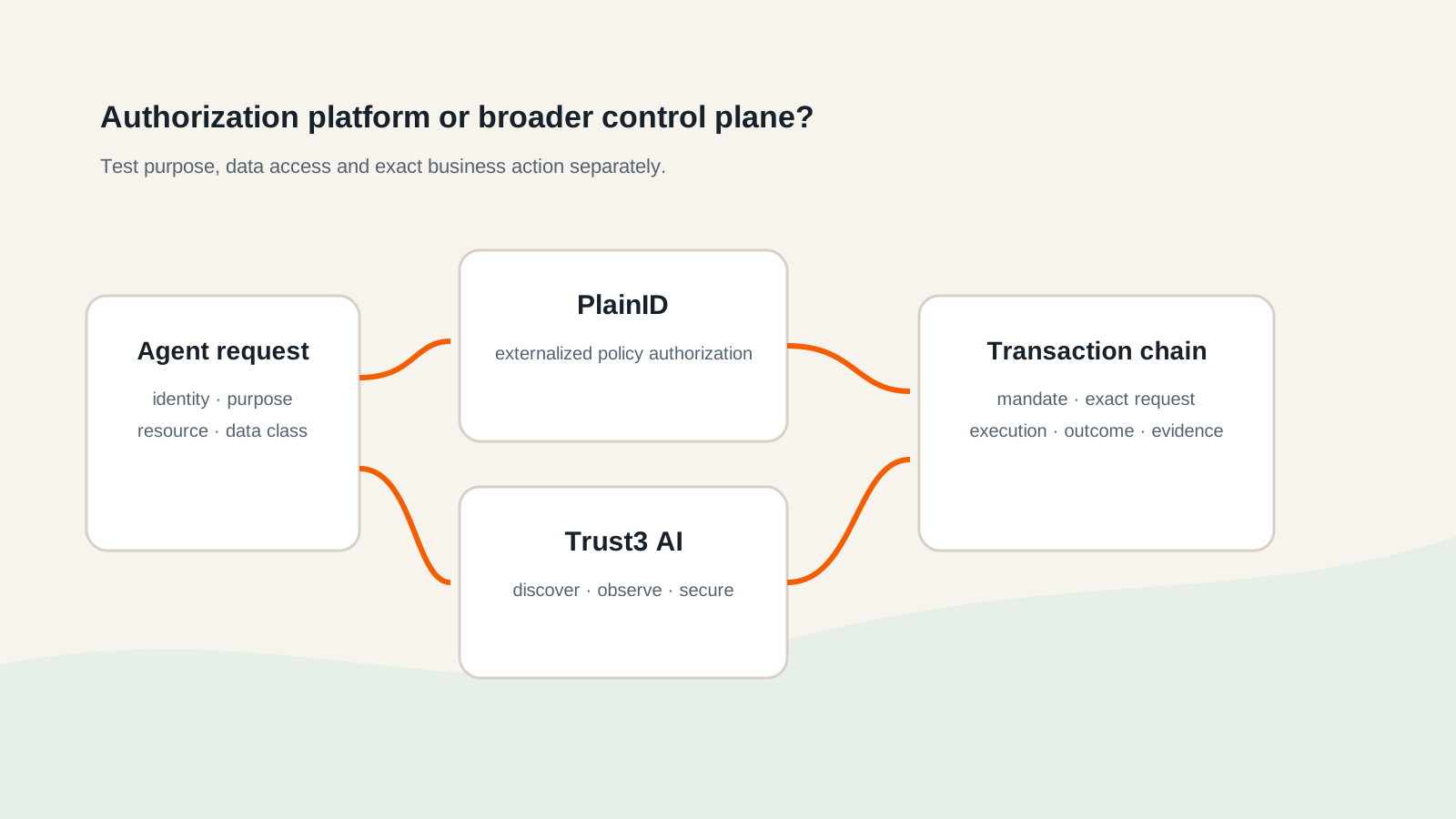
Swipe horizontally to inspect the full diagram.
PlainID's agentic AI security page describes controls at prompt input, RAG retrieval, MCP tools and response generation. It labels MCP Control beta and describes framework authorizers that embed centralized policy in agent workflows.
Trust3's agent security documentation describes purpose-based access, MCP and A2A controls, runtime guardrails and audit records. Its platform overview extends the scope to agent discovery, data access, observability and remediation. These are vendor claims and must be tested against the specific connectors and deployment model.
Enterprise agent market positioning
Product-scope analysis, not market share, quality or maturity
PlainID concentrates on authorization. Trust3 spans data governance, agent inventory, observability and runtime enforcement. Intelliger overlaps at the action decision but extends toward portable mandate, transaction state, reconciliation and action evidence.
Reviewed 17 August 2026. Read the positioning method and complete control-stack analysis.
Text summary of highlighted companies
| Company or protocol | Primary scope represented on the map |
|---|---|
| Intelliger | Transaction-specific authority, deterministic enforcement, reconciliation and portable evidence. |
| PlainID | Enterprise policy management and distributed authorization enforcement. |
| Trust3 AI | Purpose controls, grants, traces and data governance. |
| BigID | Enterprise data discovery, classification and governance. |
| Immuta | Data policy, purpose controls and governed access. |
Decide whether you need a policy engine or a broader control plane
A dedicated authorization platform can become the common policy decision point for APIs, data and agent tools. That is useful when application teams currently embed inconsistent access logic. The organization retains its identity providers and gateways while PlainID centralizes policy administration and distributes enforcement.
A broader control plane tries to answer more questions: Which agents exist? Who owns them? What data can they reach? What purpose did they declare? What happened across model, retrieval, MCP and A2A calls? Trust3 is positioned for that larger operating problem.
Broader scope can reduce integration work, but it also increases the proof burden. Buyers should verify each connector, native-enforcement claim, data path, latency characteristic and retention policy. A control-plane diagram does not establish that every production path is covered.
Combine purpose with transaction-specific fields
Purpose-based access can distinguish a support agent retrieving customer data to resolve a case from the same identity retrieving it for marketing. That is more precise than role alone.
A material action often needs additional fields:
type AgentActionContext = {
  tenantId: string;
  subject: string;
  declaredPurpose: string;
  action: 'invoice.pay' | 'refund.issue' | 'record.release';
  resource: string;
  dataClasses: string[];
  counterpartyId?: string;
  amountMinor?: number;
  currency?: string;
  destinationDigest?: string;
  mandateRef: string;
  approvalDigest?: string;
  requestDigest: string;
  observedAt: string;
};
The authorization platform can evaluate this shape directly or through an adapter such as AuthZEN. Intelliger's role is not to invent another generic policy language. It is to preserve the canonical transaction, mandate chain, non-amplification rules, approval binding, execution state and portable evidence around the decision.
Run a procurement test that includes data and action controls
Use one agent that investigates duplicate invoices and may submit a payment only after approval.
Prepare four sources: invoice records, supplier master data, purchase orders and a payment sandbox. Tag bank details and personal contact fields as sensitive. Create a normal invoice plus a duplicate whose amount differs by one cent.
Run the following fixture in each platform:
- Discover or register the agent and assign its owner and declared purpose.
- Ask for invoice context and confirm field-level filtering occurs before model context.
- Change the declared purpose and require reevaluation.
- Attempt an MCP tool whose description contains injected instructions.
- Delegate to a second agent and verify identity and purpose do not expand.
- Request payment without a mandate and require pre-execution denial.
- Approve the first invoice, then substitute the near-duplicate and require digest failure.
- Disable the policy service and confirm the payment path fails closed.
- Call the payment provider directly and test whether architecture controls prevent bypass.
- Export an evidence package and identify which fields are vendor attestations versus provider facts.
Measure decision latency, policy propagation, denied provider calls, sensitive fields entering prompts, manual remediation steps and completeness across replicas. Publish the test configuration with the result.
Failure behavior matters more than control-plane breadth
| Failure | Expected result |
|---|---|
| Agent purpose changes after data retrieval | action requires a fresh decision using current purpose |
| Data classification is unavailable | sensitive query denies or follows a documented safe fallback |
| Delegated agent presents broader scope | downstream authority remains equal or narrower |
| MCP server description contains instructions | unsafe content is removed or connection is blocked before agent context |
| Policy update reaches one replica late | version skew is visible and material calls use the required bundle version |
| Transaction amount changes after approval | request-digest binding fails |
| Provider accepts but returns no final response | outcome remains unknown and enters reconciliation |
| Audit record exists but direct API path bypasses policy | coverage test fails; logs do not prove enforcement |
Where each platform can be better than Intelliger
PlainID can be the better choice when the buyer needs a mature general authorization program across existing applications and data, not a new transaction trust protocol. Trust3 can be the better choice when the immediate problem is discovering agents, governing data access and tracing agent behavior across an enterprise estate.
Intelliger is differentiated only where the workflow needs the full transaction chain: portable delegated authority, exact-request binding, non-amplifying delegation, controlled credential release, idempotent execution, reconciliation and independently verifiable evidence. It should integrate with a customer's chosen authorization platform through a narrow decision contract.
Questions security teams ask
Is Trust3 AI a policy engine?
Trust3 documents purpose-based policies and runtime enforcement as part of a broader control plane. Buyers should verify policy semantics, administration, native enforcement and connector support for their own data and agent systems.
Does PlainID secure MCP tools?
PlainID's current AI solution page describes dynamic authorization for MCP tools and labels MCP Control beta. Require a product-version test for discovery, invocation, arguments, credentials and failure handling.
Can purpose-based access replace a mandate?
Purpose explains why access is requested. A mandate can additionally constrain who delegated authority, which action and destination are allowed, amount, cumulative budget, expiry and further delegation. The two concepts can be evaluated together.
Does Intelliger replace PlainID or Trust3?
No. A customer can keep either platform as the policy or governance layer. Intelliger should add the canonical transaction and portable authority/evidence objects around consequential actions.
Current Intelliger and OATI boundary
OATI currently implements developer-preview schemas, canonical signing, verification, deterministic mandate evaluation, non-amplifying delegation, replay controls, receipts and cross-language conformance fixtures. A reference Envoy path and deployed trust/lookup slice exist.
The commercial adapters for PlainID or Trust3, full policy compiler, hardened enforcement fleet, durable evidence and dispute service, independent protocol review and production acceptance remain incomplete. No claim in this comparison should imply equivalent platform breadth or production maturity.
Start with the AI agent authorization guide, place the decision inside the enterprise agent control stack and review why identity alone cannot approve the action.
Expert review required before publication: an authorization and data-governance practitioner should validate product status, connector assumptions, enforcement placement and the evaluation fixture.
To test a transaction-aware authorization contract, review the Agent Trust architecture and contact Intelliger.