
Best AI Agent Authorization Platforms for Enterprises in 2026
Compare AI agent authorization platforms, policy engines and standards across runtime context, MCP controls, enforcement and evidence.

The best AI agent authorization platform depends on whether you need enterprise policy administration, a broad agent control plane or an embeddable policy engine. PlainID fits organizations that want managed policy and distributed enforcement. Trust3 fits teams prioritizing agent traces, purpose and data controls. OPA fits domain-neutral policy as code. Cedar fits application teams that want a typed principal-action-resource-context model. AuthZEN 1.0 is the interoperability API to require across these choices, not another policy engine.
This shortlist is based on public documentation reviewed on 17 August 2026. It does not claim a comparative latency benchmark or independent security certification.
Best AI agent authorization platforms by control problem
| Control problem | Best starting point | Why | Procurement caveat |
|---|---|---|---|
| Central enterprise policy management | PlainID | Managed authorization, distributed decision and enforcement patterns, agent and MCP positioning | Confirm the exact status and parameter controls in the purchased edition |
| Agent purpose, traces and data governance | Trust3 AI | Agent discovery, grants, purpose and activity context in one agent-focused control plane | Validate enforcement coverage against each framework and direct API path |
| General policy as code across infrastructure | Open Policy Agent | Open-source, domain-neutral Rego engine with local and service deployment patterns | Your team owns the domain model, bundle operations and enforcement integration |
| Application authorization with typed schemas | Cedar | Principal, action, resource and context model with default-deny semantics | Cedar is a language and evaluator, not a complete enterprise control plane |
| PDP and PEP interoperability | AuthZEN Authorization API 1.0 | Standard request and decision interface between enforcement and policy systems | The standard does not define your business mandate or provider outcome state |
| Exact cross-company transaction control | Intelliger and OATI, developer preview | Portable mandate, non-amplification, exact request binding and receipts | Hardened commercial enforcement and production acceptance remain incomplete |
Swipe horizontally to inspect the full diagram.
PlainID presents its AI authorization solution as policy management for agent inputs, retrieval, outputs and MCP actions. Trust3 describes purpose controls, grants and agent activity in its agent security platform. Treat both as vendor-documented capabilities and verify them in the intended environment.
OPA is an open-source general-purpose policy engine that accepts structured input and separates decision from enforcement. Its deployment guidance recommends locating OPA close to the policy enforcement point when latency and reliability matter. Cedar 4.5 documents policies over principal, action, resource and context and uses deny-overrides with default deny. Cedar's authorization algorithm explains those semantics.
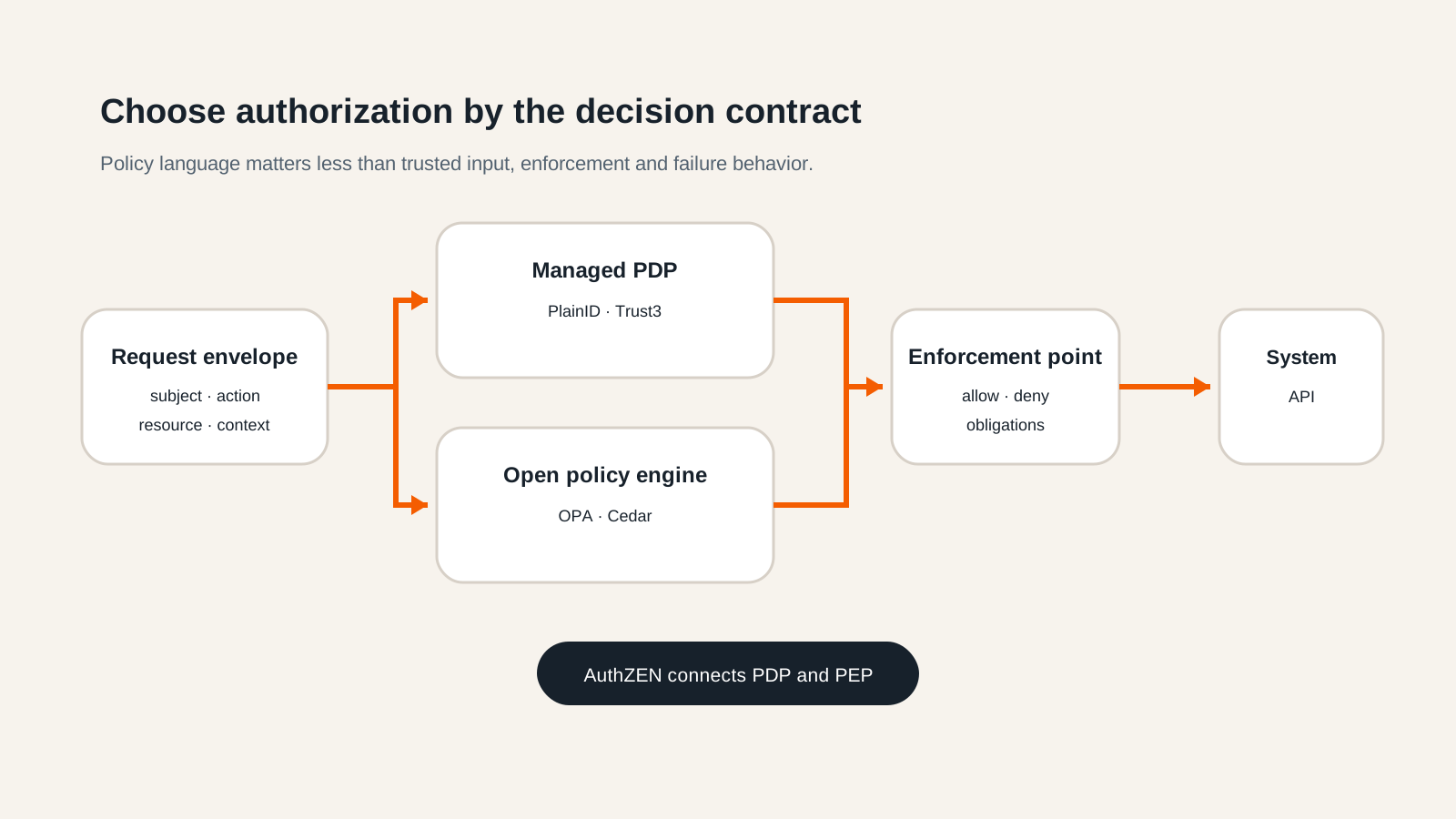
The OpenID Foundation approved Authorization API 1.0 as final in January 2026. It standardizes evaluation and search interfaces between a policy enforcement point and policy decision point. It deliberately does not standardize the internal policy language.
Enterprise agent market positioning
Product-scope analysis, not market share, quality or maturity
PlainID and Trust3 occupy managed policy and agent-control territory. Kong and Portkey are enforcement and traffic locations. Intelliger adds transaction-specific authority and evidence while integrating with those systems. Coordinates show scope, not product quality.
Reviewed 17 August 2026. Read the positioning method and complete control-stack analysis.
Text summary of highlighted companies
| Company or protocol | Primary scope represented on the map |
|---|---|
| Intelliger | Transaction-specific authority, deterministic enforcement, reconciliation and portable evidence. |
| PlainID | Enterprise policy management and distributed authorization enforcement. |
| Trust3 AI | Purpose controls, grants, traces and data governance. |
| Kong | LLM, MCP and A2A traffic gateway, authentication and observability. |
| Portkey | AI and MCP gateway, credential isolation, observability and guardrails. |
Normalize one decision contract before selecting a platform
Authorization breaks when the input contract omits facts that change the business decision. Define one payload that every candidate must evaluate before comparing policy languages:
type AgentAuthorizationInput = {
  subject: {
    tenantId: string;
    agentId: string;
    ownerRefs: string[];
    lifecycle: 'active' | 'inactive' | 'unknown';
  };
  action: 'invoice.read' | 'payment.submit' | 'refund.issue';
  resource: { type: string; id: string; destinationDigest?: string };
  context: {
    purpose: string;
    amountMinor?: number;
    currency?: string;
    requestDigest: string;
    mandateRef: string;
    approvalRef?: string;
    observedAt: string;
  };
};

type AgentAuthorizationDecision = {
  result: 'allow' | 'deny' | 'approval_required' | 'indeterminate';
  decisionId: string;
  policyVersion: string;
  requestDigest: string;
  obligations: string[];
  expiresAt: string;
};
AuthZEN can carry a portable access-evaluation shape between the enforcement point and PDP. The transaction fields and result extensions still require an agreed profile. Do not reduce approval_required or indeterminate to an optimistic allow.
Run a policy portability fixture
Use one supplier-payment request and implement the same rules in every candidate:
- Deny by default.
- Require active agent status and the expected tenant.
- Allow invoice read for the approved purpose.
- Permit payment submission only to an allow-listed supplier and destination.
- Require independent approval above a test threshold.
- Bind approval to
requestDigestrather than the invoice number alone. - Reserve shared budget atomically before credential release.
- Deny if required context is stale, unavailable or ambiguous.
- Return the deciding policy version and obligations.
- Execute through the intended policy enforcement point, then attempt a direct bypass.
Measure decision latency locally and under control-plane outage. Also measure policy propagation, stale-data behavior, explanation quality, rollback and the effort required to add a second enforcement point.
Failure tests that matter more than policy syntax
| Failure | Safe result | Evidence to retain |
|---|---|---|
| Supplier status service times out | Indeterminate or deny for payment | Input freshness and dependency failure |
| Approval belongs to old request digest | Deny | Presented and expected digest |
| Second delegation hop expands amount | Deny | Parent and child constraints |
| Policy bundle is unavailable | Use an explicitly approved cached version or fail closed | Bundle version and cache age |
| PDP allows but gateway can be bypassed | Block direct path or mark assurance incomplete | Network and credential-release evidence |
| Provider accepts then times out | Keep outcome unknown | Provider idempotency key and reconciliation state |
Where Intelliger fits
Intelliger should not replace PlainID, Trust3, OPA or Cedar when one already governs enterprise policy. The intended contract supplies a canonical transaction, mandate chain, approval binding and obligations to the selected PDP through AuthZEN or an adapter. An enforcement component then verifies the returned decision before releasing a short-lived provider credential.
OATI's current developer preview includes signed objects, deterministic mandate evaluation, replay controls, receipts and cross-language conformance fixtures. The complete policy compiler, production PlainID and Trust3 adapters, hardened gateway, durable evidence service, independent review and two-enterprise acceptance are incomplete.
Questions buyers ask
Is AuthZEN an authorization platform?
No. It is a standard API between policy decision and enforcement points. A product or open-source engine still evaluates the policy, and the application still enforces the result.
Should we use OPA or Cedar for agents?
Use OPA when you need a general engine across varied infrastructure and are comfortable owning Rego and bundle operations. Use Cedar when the application naturally fits its principal-action-resource-context model and typed schemas. Test both with the same agent transaction.
Can an MCP gateway be the policy enforcement point?
Yes, if every relevant tool call flows through it and it receives enough trusted context. Direct credentials, alternate routes and asynchronous execution can break that assumption.
Does an allow decision prove the action happened correctly?
No. Authorization precedes execution. The provider outcome, reconciliation and evidence belong to later states.
Start with the canonical AI agent authorization guide, compare PlainID with Trust3 AI and use the MCP tool-call authorization fixture.
Expert review required before publication: an authorization architect should verify product status, AuthZEN profile assumptions, policy examples and outage behavior.
To test the existing open transaction and mandate objects, open OATI developer resources.