
Best AI Agent Identity Platforms for Enterprises in 2026
Compare AI agent identity platforms for lifecycle, ownership, discovery, credentials, access governance and exact transaction control.

The best AI agent identity platform depends on the identity estate you already operate. Microsoft Entra Agent ID is the strongest starting point for Microsoft-centered organizations. Okta fits mixed SaaS environments already governed through Okta. SailPoint fits identity governance and certification across several agent platforms. Aembit and Oasis address workload credentials and non-human identity risk. None should be treated as approval for a specific payment, refund or production change.
This is a documentation-based buying guide, not a paid ranking or hands-on performance benchmark. Product status, connectors and licensing can change. Recheck the linked first-party documentation during procurement.
Best AI agent identity platforms by enterprise need
| Enterprise need | Best starting point | Documented strength | Important boundary |
|---|---|---|---|
| Native Microsoft agent identity | Microsoft Entra Agent ID | Agent identities, blueprints, sponsors, lifecycle, permissions and sign-in records | Microsoft access does not encode every business transaction constraint |
| Mixed SaaS identity control plane | Okta for AI Agents | Agent registration, lifecycle, connections, public keys and token exchange | The current developer API is labeled beta |
| Cross-platform access certification | SailPoint Agent Identity Security | Agent aggregation, ownership, access review and entitlement governance | Certification does not establish the truth of every runtime input |
| Secretless workload access | Aembit | Blended user and workload identity, short-lived credentials and MCP gateway controls | Credential release still needs a precise business decision for material actions |
| NHI discovery and access posture | Oasis Security | Agent and NHI discovery, permission mapping, ephemeral access and policy | Intent extraction should not be the only source of authority |
| Public cross-organization identity | Concordium Agent Registry | Public registry identity, owner account and integrity-protected Agent Card | Registry status does not prove capability truth or transaction permission |
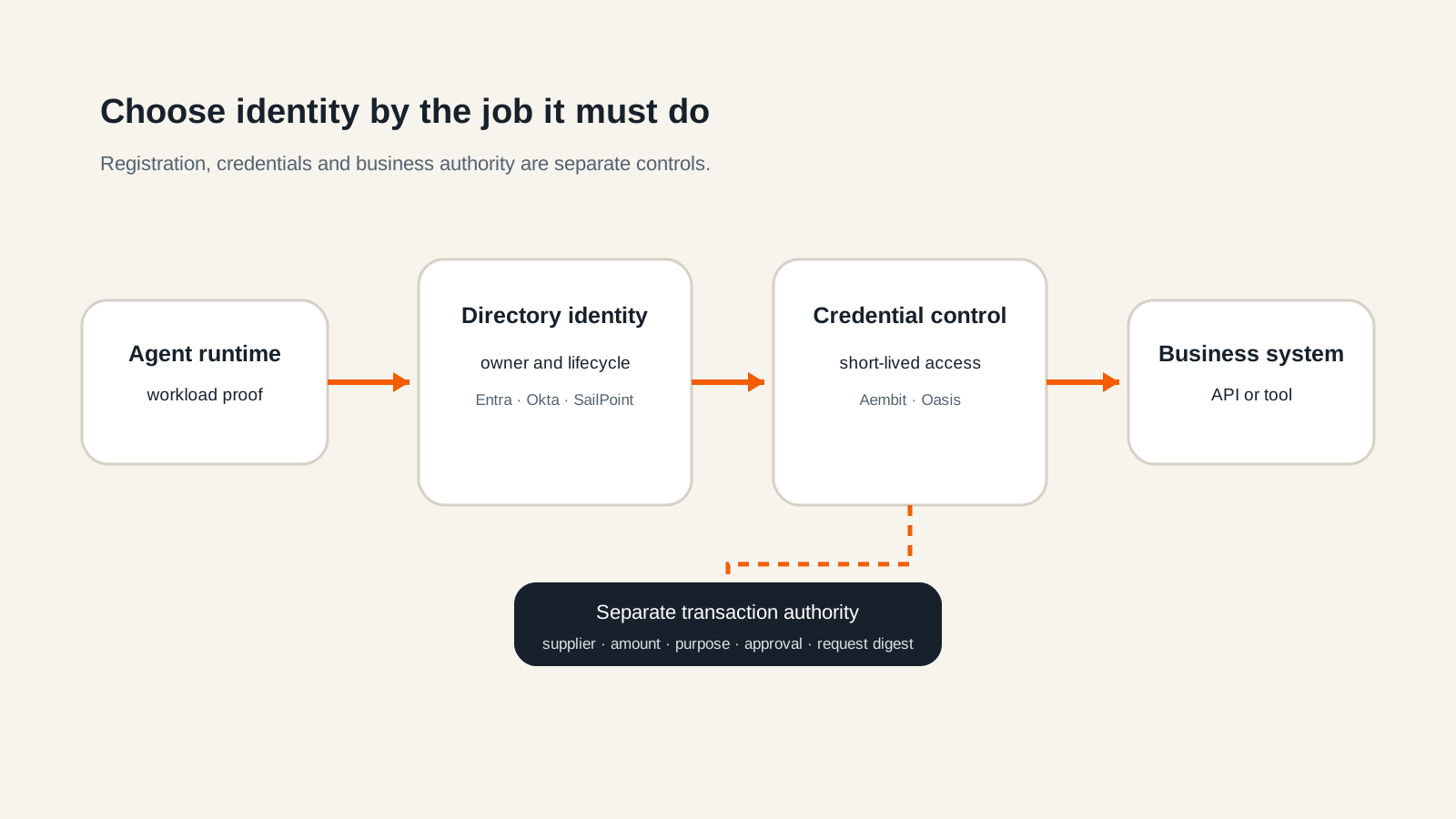
Swipe horizontally to inspect the full diagram.
Microsoft describes agent identities as distinct Entra accounts for AI agents, with autonomous or delegated access and management at agent, blueprint and tenant scope. Entra Agent ID concepts and administration guidance support that fit.
Okta documents agent registration, lifecycle, application relationships, public-key credentials and token exchange. Okta's AI Agents API currently describes the object model and lifecycle. SailPoint says its Agent Identity Security product aggregates agents, assigns ownership and supports certification and governance. SailPoint's product explanation is the first-party basis for that row.
Aembit treats an agent as a workload and can combine the user's identity with the agent's workload identity. Its AI agent access documentation describes credential isolation, per-user scoping and revocation. Oasis describes discovery, deterministic policy and short-lived access in its Agentic Access Management overview.
Enterprise agent market positioning
Product-scope analysis, not market share, quality or maturity
Identity platforms cluster around inventory, ownership, lifecycle and access. Intelliger is positioned farther toward exact business authority, controlled execution and portable transaction evidence. The horizontal and vertical coordinates describe scope, not product maturity.
Reviewed 17 August 2026. Read the positioning method and complete control-stack analysis.
Text summary of highlighted companies
| Company or protocol | Primary scope represented on the map |
|---|---|
| Intelliger | Transaction-specific authority, deterministic enforcement, reconciliation and portable evidence. |
| Concordium | Verified ownership, agent registry and identity-linked transaction infrastructure. |
| Okta for AI Agents | Agent identity, lifecycle, access and governance. |
| Microsoft Entra Agent ID | Enterprise agent identity, ownership, lifecycle and Microsoft ecosystem access. |
| SailPoint | Agent inventory, ownership, access review and entitlement governance. |
| Oasis Security | Non-human identity discovery, permissions and just-in-time identity controls. |
| Aembit | Workload identity and secretless just-in-time access for agents and MCP. |
Define the identity job before comparing vendors
An enterprise agent can carry several identities at once. A directory identity answers which enterprise object represents it. A workload identity proves which runtime is calling. A delegated user identity records the human context. A public registry identity gives an external party a resolvable reference.
Put those findings into a projection instead of passing raw tokens through the agent:
type AgentIdentityProjection = {
  tenantId: string;
  subject: string;
  directory: 'entra' | 'okta' | 'other';
  workloadSubject?: string;
  accountableOwnerRefs: string[];
  lifecycle: 'active' | 'inactive' | 'unknown';
  credentialAudience: string;
  assurance: string[];
  observedAt: string;
};
The projection is one input to authorization. It should not contain a guessed supplier, amount, purpose or destination. Those fields belong to the transaction and its mandate.
Run one lifecycle and abuse fixture
Choose one agent that reads invoices and can propose, but not submit, a payment. Run the same fixture against every shortlisted platform:
- Discover or register the agent and attach a named accountable owner.
- Issue a runtime credential without putting the credential in the prompt or model trace.
- Confirm the receiving system checks issuer, audience, subject and expiry.
- Disable the agent and measure how quickly every access path stops.
- Change ownership and preserve historical attribution.
- Request an unapproved resource and require denial.
- Keep authentication valid, change the payment amount and require the transaction policy to deny it.
- Attempt a direct provider call that bypasses the intended enforcement point.
- Export enough evidence to explain identity, authority, approval, execution and final outcome.
Record product edition, connector, tenant type, cache interval, timestamps and manual operations. A successful sign-in is only the start of this test.
Failure cases buyers should require
| Failure | Identity platform should do | Transaction layer should do |
|---|---|---|
| Agent is disabled during a cached session | Stop new credentials inside the documented freshness window | Deny a material action when status is stale or unknown |
| Valid subject presents another tenant's mandate | Preserve authenticated subject and tenant claims | Reject the tenant mismatch |
| Agent has write scope but exceeds its budget | Keep the identity decision explainable | Reject amount or shared-budget expansion |
| Approval refers to a different request | Preserve approver identity | Reject the approval digest mismatch |
| Workload credential leaks into a trace | Support rotation and incident review | Keep provider credentials outside model context |
| Provider times out after accepting a request | Preserve caller attribution | Hold the transaction in unknown state and reconcile |
Where Intelliger is complementary
Intelliger should consume the chosen enterprise identity rather than create a rival directory. The intended integration maps the verified subject, tenant, owner, workload proof and lifecycle status into a canonical transaction. OATI can then bind a portable mandate, a deterministic decision and any human approval to the exact request digest.
The existing developer preview includes schemas, canonical signing, verification, deterministic evaluation, replay checks, receipts, a 73-case cross-language conformance suite and a deployed trust and lookup slice. The commercial identity adapters, hardened enforcement fleet, complete policy compiler, durable evidence service, independent protocol review and production acceptance are incomplete.
Questions buyers ask
Do I need an AI-specific identity object?
Use one when it improves inventory, ownership, lifecycle and audit without breaking established IAM operations. A conventional workload identity can still be valid for a bounded agent if ownership and agent purpose remain explicit.
Is non-human identity management enough for autonomous agents?
It covers an important credential and lifecycle layer. Autonomous business actions also need transaction context, policy, approval, idempotency, outcome reconciliation and evidence.
Should Entra or Okta remain authoritative?
Usually yes. Choose one authoritative enterprise lifecycle record. Map it into gateways, policy systems and transaction controls rather than creating competing ownership records.
Can a public registry replace enterprise IAM?
Usually not. A public registry can help external resolution. Internal joiner, mover, leaver, incident and access-review processes still belong in the enterprise identity system.
Read the AI agent identity versus authorization guide, compare Microsoft Entra Agent ID with Okta and place identity inside the enterprise agent control stack.
Expert review required before publication: an enterprise identity architect should verify release labels, connector coverage, licensing assumptions and the revocation fixture.
To map one existing identity flow into an exact business transaction, review Agent Trust and contact Intelliger.