
Best Enterprise Knowledge Graphs for AI Agents in 2026
Compare enterprise knowledge graph platforms for AI agents across GraphRAG, virtual data, operational actions, provenance and permissions.

The best enterprise knowledge graph for AI agents depends on the job. Neo4j is a strong fit for graph-native applications and GraphRAG. Stardog fits semantic virtualization across data that should remain in existing systems. Palantir Ontology fits organizations modeling data, logic, actions and security in one operational platform. OriginTrail fits public or cross-organization knowledge that needs provenance and ownership anchoring. None of these platforms should be mistaken for a transaction mandate or final business authorization.
This is a documentation-based architecture shortlist. It does not rank query performance, total cost or implementation effort because those require a workload-specific benchmark and commercial proposals.
Best enterprise knowledge graphs for AI agents by job
| Agent context job | Best starting point | Documented strength | Boundary to verify |
|---|---|---|---|
| Graph-native retrieval and GraphRAG | Neo4j | Property graph, traversal, vector retrieval and Aura Agent integration | Define temporal validity, source lineage and application authorization explicitly |
| Federated semantic layer | Stardog | RDF semantics and virtual graphs over existing data sources | Test source freshness, query planning and permission propagation at your scale |
| Operational ontology and actions | Palantir Ontology | Objects, links, logic, actions, dynamic security and operational workflows | Distinguish platform action permission from portable cross-company authority |
| Verifiable shared knowledge | OriginTrail DKG | RDF Knowledge Assets, provenance, ownership and cryptographic state anchoring | A valid proof establishes integrity, not the truth of every assertion |
| Transaction-specific decision context | Intelliger target architecture | Minimum permission-aware facts bound to one transaction and evidence chain | It is not intended to replace the primary graph, catalog or operational system |
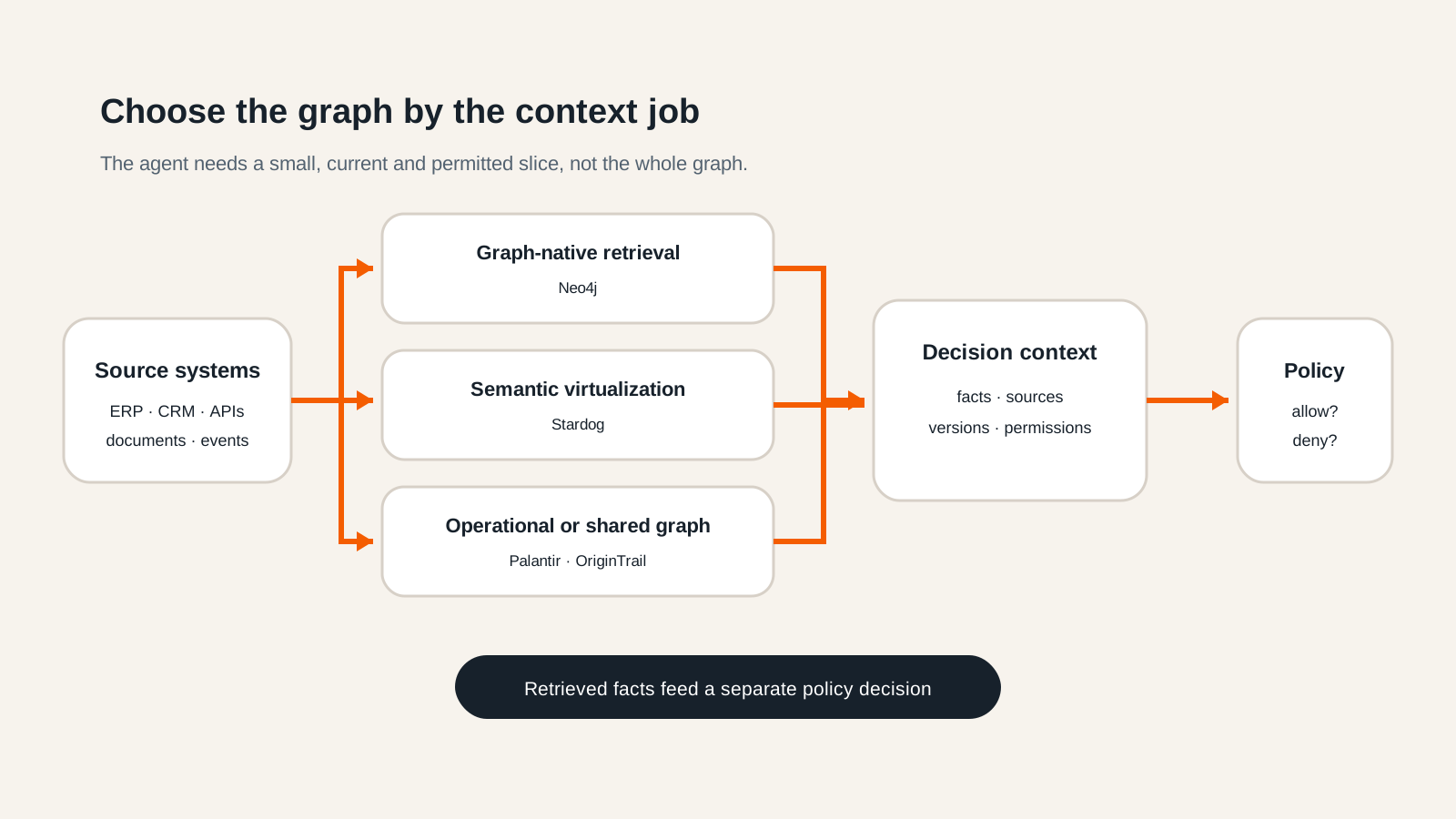
Swipe horizontally to inspect the full diagram.
Neo4j positions its platform for graph-based context, GraphRAG and agent memory. Neo4j's AI systems overview describes traversal, structured and unstructured data and GraphRAG, while Aura Agent can expose graph-grounded agents through an API or MCP server.
Stardog's Designer documentation describes virtual graphs that map external data sources without first copying all source data. Palantir's Ontology architecture joins data, logic, actions and security in an operational representation used by people and agents.
OriginTrail represents knowledge as RDF and vector data with blockchain-anchored integrity proofs and ownable locators. Its DKG repository distinguishes private, shared and verifiable memory and explains how published graph assets can be verified.
Enterprise agent market positioning
Product-scope analysis, not market share, quality or maturity
OriginTrail sits in shared context and provenance. Trust3 and PlainID supply purpose, data and policy controls around use. Intelliger is positioned where selected facts, authority and action are bound to one transaction. The chart is a scope map, not a graph-platform ranking.
Reviewed 17 August 2026. Read the positioning method and complete control-stack analysis.
Text summary of highlighted companies
| Company or protocol | Primary scope represented on the map |
|---|---|
| Intelliger | Transaction-specific authority, deterministic enforcement, reconciliation and portable evidence. |
| OriginTrail | Shared context graphs, provenance and decentralized knowledge infrastructure. |
| PlainID | Enterprise policy management and distributed authorization enforcement. |
| Trust3 AI | Purpose controls, grants, traces and data governance. |
A knowledge graph is not yet a decision context
Agents rarely need the whole graph. They need a small, current and permitted slice for one decision. Define that output explicitly:
type DecisionContextFact = {
  factId: string;
  subjectRef: string;
  predicate: string;
  object: string | number | boolean;
  sourceRef: string;
  sourceVersion: string;
  observedAt: string;
  validFrom?: string;
  validUntil?: string;
  permissionDecisionRef: string;
  confidence?: number;
};

type TransactionDecisionContext = {
  transactionId: string;
  purpose: string;
  facts: DecisionContextFact[];
  contextDigest: string;
  assembledAt: string;
};
The graph can supply supplier ownership, invoice relationships, sanctions status, asset location or contract terms. A policy still decides whether those facts permit this agent to perform this action. The source system still owns volatile truth such as current balance, inventory or settlement state.
Run a context quality benchmark before buying
Choose one consequential question, such as whether an invoice is a duplicate. Build a fixture with twenty known relationships and five deliberate traps:
- Two suppliers share a similar name but different legal identifiers.
- One invoice number is reused in another subsidiary.
- One purchase order was amended after the indexed snapshot.
- One relationship is visible to the controller but not the agent.
- One external provenance proof is valid while the underlying assertion is false.
For each candidate, record:
- precision and recall for the required facts;
- source and relationship traceability;
- permission leakage across users, agents and tenants;
- time from source update to query visibility;
- behavior when a source is unavailable;
- deterministic reproduction of the selected context;
- effort to export the facts and versions used in a later audit.
Do not score only the final LLM answer. Score the retrieved facts before model generation. That separates graph and retrieval defects from model behavior.
Failure cases that expose architecture differences
| Failure | What can go wrong | Required response |
|---|---|---|
| Source record changes after indexing | Agent reasons from stale price, status or ownership | Carry source version and freshness, then refresh or deny |
| Graph edge is visible but underlying object is restricted | Relationship leaks sensitive existence | Enforce permissions on nodes, edges and derived answers |
| Entity resolution merges two suppliers | Agent applies the wrong contract or destination | Preserve legal identifiers and reversible merge evidence |
| Provenance hash verifies | Team assumes the assertion is true | Report integrity and factual validation separately |
| Graph query succeeds but policy data is unavailable | Agent treats knowledge as permission | Return indeterminate or deny for material action |
| LLM writes memory back into the graph | Generated inference becomes an unmarked fact | Separate observations, inferences and approved assertions |
Choose by operating model as well as graph model
Neo4j gives application teams direct control over a graph-native workload and is a practical choice when traversal and GraphRAG are central. Stardog is attractive when the organization wants semantic relationships across warehouses and databases without copying all data into one store. Palantir is broader: its Ontology includes operational actions, functions, security and workflow, which can reduce integration work for organizations already committed to Foundry and AIP.
OriginTrail solves a different problem. It is most relevant when knowledge must cross organizational boundaries with independently verifiable provenance and ownership. Its public-network and token model introduce privacy, governance and operating questions that an internal graph may avoid.
Where Intelliger is complementary
Intelliger should not sell a primary enterprise knowledge graph. Its target decision-context service would query Neo4j, Stardog, Palantir, OriginTrail, a warehouse or operational APIs, then package the minimum allowed facts with source versions and a context digest for one transaction.
That context becomes an input to deterministic authority and policy. OATI can already bind signed identities, mandates, decisions and receipts in a developer preview. The broad knowledge-platform adapters, decision-context service, adaptive intelligence and commercial context graph are target architecture, not shipped product.
Questions buyers ask
Is a knowledge graph better than a vector database for agents?
They solve different retrieval problems. Graphs preserve named relationships and support traversal. Vector indexes retrieve semantically similar content. Many agent systems need both, plus filters and live source calls.
Can the graph enforce agent permissions?
Some platforms have granular security and action controls. Test whether those permissions propagate through graph traversal, derived facts, caches, embeddings, tools and exported context.
Does blockchain provenance make knowledge true?
No. It can establish who published a record and whether the bytes or state changed. Factual validation requires trusted sources, tests or corroborating evidence.
Should the agent write its memory back to the enterprise graph?
Only through an explicit workflow that labels generated inferences, validates schemas, preserves provenance and supports correction. Model output should not silently become an enterprise fact.
Compare OriginTrail DKG with an enterprise knowledge graph, review the commerce outcome-data architecture and place context inside the enterprise agent control stack.
Expert review required before publication: a knowledge-graph architect, data-governance specialist and AI evaluation lead should verify product status, permission assumptions and the benchmark fixture.
To discuss transaction-specific context without replacing the enterprise graph, contact Intelliger.