
OriginTrail DKG vs Knowledge Graph vs Agent Memory
Compare OriginTrail DKG, enterprise knowledge graphs and agent memory by ownership, provenance, sharing, freshness, access and action control.

OriginTrail DKG, an enterprise knowledge graph and agent memory solve related but different problems. A knowledge graph models entities and relationships inside an organizational domain. Agent memory retains task-relevant state across interactions. OriginTrail DKG adds peer-to-peer sharing, cryptographic provenance and decentralized publication. None of the three automatically grants an agent permission to perform a business action.
This article is for enterprise architects asking whether OriginTrail replaces an existing graph platform, whether a graph can serve as agent memory and how trustworthy context should enter a controlled transaction.
What is the difference in one table?
| Question | Enterprise knowledge graph | Agent memory | OriginTrail DKG |
|---|---|---|---|
| Primary job | model and query connected enterprise facts | retain useful state for one agent or workflow | publish, verify and query shared graph knowledge across nodes |
| Typical owner | one enterprise or business domain | agent application or orchestration team | participating node operators and context-graph governance |
| Common representation | RDF, property graph, ontology and domain IDs | messages, summaries, vectors, events or structured working state | RDF assertions, knowledge assets and context graphs |
| Provenance | defined by enterprise lineage and governance | often application-specific | cryptographic and network-verifiable publication mechanisms |
| Freshness | depends on source integration and temporal model | depends on memory write and retrieval policy | depends on assertion lifecycle, synchronization and source updates |
| Sharing boundary | enterprise roles and data policy | runtime, user or tenant scope | local, shared and on-chain anchored memory tiers |
| Best use | master relationships, semantic integration and governed retrieval | continuity, plans, tool results and task state | multi-party or multi-agent context that benefits from portable provenance |
| Does it authorize an action? | no | no | no |
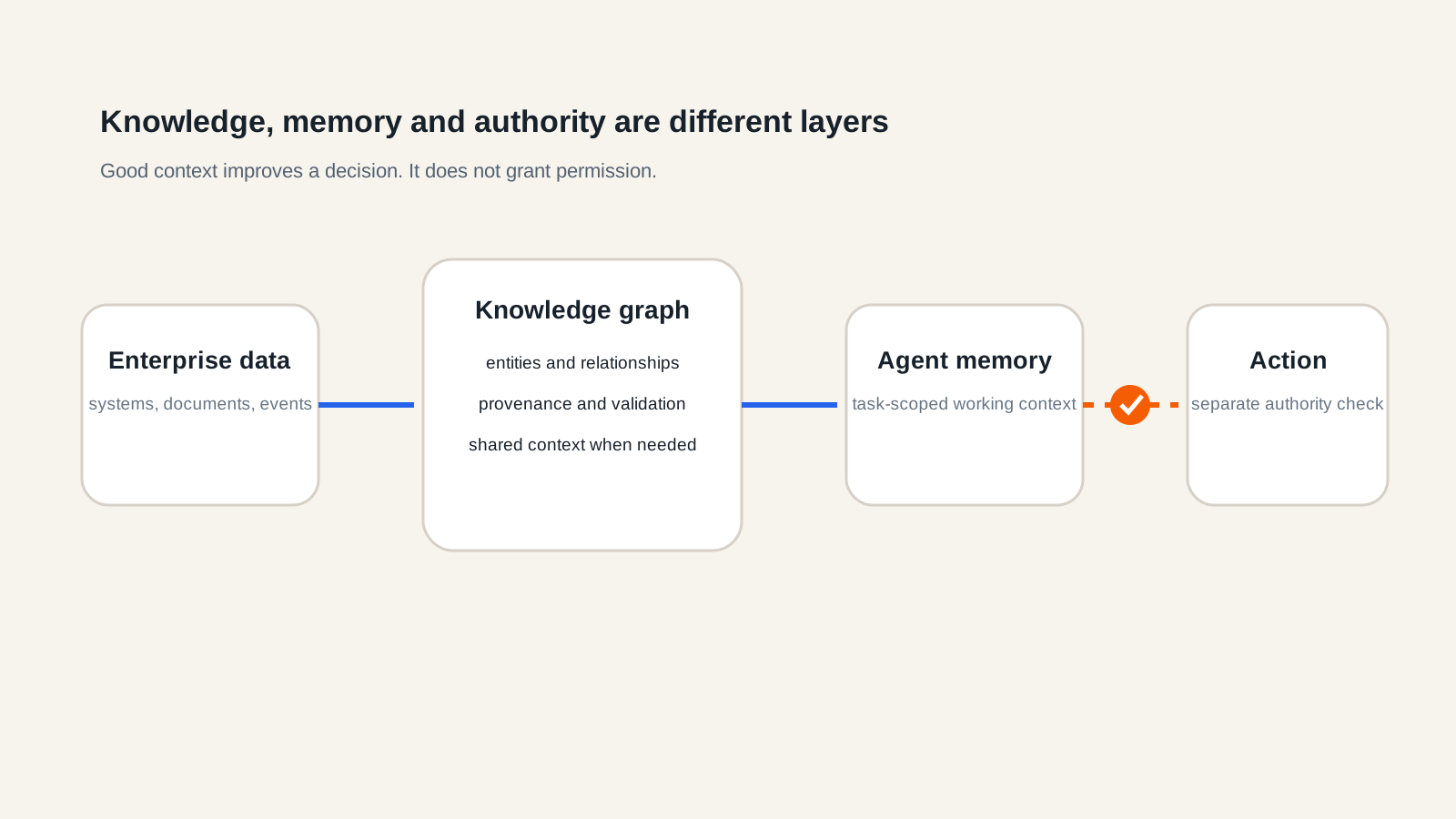
Swipe horizontally to inspect the full diagram.
OriginTrail describes its DKG as decentralized knowledge infrastructure for multi-agent memory. Its V10 repository includes context graphs, RDF stores, SPARQL, a three-layer memory model, agent discovery and MCP integration. The same repository states that V10 is a release candidate on testnet and is not yet recommended for production workloads. OriginTrail's DKG repository is the most direct source for both the implemented scope and maturity boundary.
What an enterprise knowledge graph does well
An enterprise graph creates stable, queryable relationships across systems whose identifiers and schemas do not naturally agree. A procurement graph might connect:
supplier -> legal entity -> bank account
supplier -> approved category -> contract
invoice -> purchase order -> receipt
plant -> region -> export restriction
employee -> cost center -> approval role
The value is not that every fact sits in one database. It is that the graph gives facts common identifiers, typed relationships and a governed route back to source systems.
Validation still matters. RDF says how to express graph statements; it does not guarantee their business quality. SHACL defines shapes that validate RDF data against stated conditions and returns structured validation results. The W3C SHACL Recommendation is useful for enforcing graph contracts such as required identifiers, value types and allowed relationship patterns.
For agent use, add temporal and permission fields. A graph edge that says a supplier is approved should include the approving source, effective interval, jurisdiction and observed time. A query must filter by the requesting tenant and purpose before retrieval, not after the model has seen the data.
What agent memory does well
Agent memory exists to preserve continuity. It may include recent messages, a compact summary, tool results, unresolved tasks, preferences and stable references to external records.
Treat memory as several stores rather than one endless transcript:
| Memory tier | Example | Retention and trust rule |
|---|---|---|
| Working memory | current invoice, proposed action, latest tool result | short-lived and scoped to the active transaction |
| Episodic memory | previous attempt, timeout, reviewer feedback | retained with event time and source reference |
| Semantic memory | supplier alias, policy definition, product relationship | versioned and retrieved from a governed source |
| Procedural memory | approved workflow or tool-use pattern | released and tested like code or policy |
A vector index can help retrieve similar text, but similarity does not establish truth, freshness or permission. A summary can preserve meaning efficiently, but it may omit the one field that changes authorization. Keep stable identifiers and protected values in typed state, then let the model use prose around them.
What OriginTrail adds
OriginTrail's model is most interesting when context crosses agent, team or organizational boundaries. Its documentation describes a DKG where knowledge is published as structured assets with provenance, query and proof mechanisms. The V10 materials add local working memory, shared working memory and verifiable memory plus open or curated context graphs. OriginTrail's DKG overview describes the current three-layer memory direction.
That can add value when:
- several agents need a shared record of decisions or facts;
- participants do not want one vendor to control the memory service;
- a consumer must check who published an assertion and whether it changed;
- RDF and SPARQL interoperability matter;
- knowledge should move between agent frameworks through MCP or HTTP.
It adds operational questions too. Teams must decide which claims deserve shared publication, who may curate a context graph, how private data remains local, how deletions and corrections propagate, what blockchain anchoring proves and what happens during testnet or network disruption.
Cryptographic provenance can show that a given publisher committed to a given record. It does not prove the record was factually correct. The relying agent still needs issuer policy, source corroboration, freshness requirements and conflict handling.
Where OriginTrail and Intelliger sit
Enterprise agent market positioning
Product-scope analysis, not market share, quality or maturity
OriginTrail, BigID, Immuta and AGNTCY operate primarily in context, data, policy or open agent infrastructure. Intelliger consumes those signals at a later transaction boundary, where an exact action is authorized, executed and reconciled.
Reviewed 17 August 2026. Read the positioning method and complete control-stack analysis.
Text summary of highlighted companies
| Company or protocol | Primary scope represented on the map |
|---|---|
| Intelliger | Transaction-specific authority, deterministic enforcement, reconciliation and portable evidence. |
| OriginTrail | Shared context graphs, provenance and decentralized knowledge infrastructure. |
| BigID | Enterprise data discovery, classification and governance. |
| Immuta | Data policy, purpose controls and governed access. |
| AGNTCY | Open agent discovery, identity, messaging and observability infrastructure. |
Intelliger should not build a replacement for OriginTrail or a customer's primary knowledge graph. Its context responsibility is narrower: assemble the minimum current facts needed to decide one transaction, retain their provenance and bind the selected snapshot to the request digest.
The boundary can look like this:
enterprise systems and graph
  -> permission-aware context query
  -> optional OriginTrail knowledge assertion or context-graph reference
  -> task-scoped context snapshot
  -> agent proposal
  -> mandate and deterministic business policy
  -> execution through the authoritative system
  -> reconciled outcome and signed receipt
OriginTrail is the better fit when the core problem is shared, portable and verifiable knowledge. Intelliger is the better fit when the core problem is whether an identified agent may perform one consequential action and how that decision stays bound to execution. They are complementary when a transaction depends on context supplied by several parties.
Bind context without turning it into permission
A context snapshot should name the facts used by policy without copying an entire graph into the transaction:
type ContextSnapshot = {
  snapshotId: string;
  transactionId: string;
  purpose: 'invoice_payment_review';
  observedAt: string;
  facts: Array<{
    subject: string;
    predicate: string;
    object: string;
    source: string;
    sourceVersion?: string;
    effectiveAt?: string;
    expiresAt?: string;
  }>;
  graphRefs: string[];
  digest: `sha256:${string}`;
};
This is illustrative. A production profile must define canonicalization, privacy, redaction and field-level access. The transaction envelope should reference snapshot.digest. If a protected fact changes after approval, create a new snapshot, recompute the transaction and reevaluate.
Do not write supplier.approved = true into long-term agent memory without its source and validity interval. The statement may have been true yesterday and unsafe today.
Test the context pipeline with contradictory facts
Create a reproducible four-record fixture:
source-a: supplier-17 status=approved observed=09:00
source-b: supplier-17 status=suspended observed=09:05
memory:   supplier-17 status=approved summarized=08:55
dkg:      supplier-17 certification=valid published=08:40
Then ask the system to approve a new order at 09:10. A safe implementation should not choose the most semantically similar statement. It should apply an explicit precedence and freshness rule.
| Failure | Expected handling |
|---|---|
| Two authoritative sources conflict | return conflict or escalate; do not let the model choose silently |
| Graph assertion has valid proof but unknown issuer policy | integrity passes; trust result remains unknown |
| Memory summary omits a suspension time | typed current source overrides the summary |
| Context was retrieved for another tenant | deny before the data reaches model context |
| Source changes after transaction approval | invalidate or reevaluate under the action's freshness policy |
| DKG node is unavailable | use an explicitly permitted cached assertion or stop the dependent action |
| Deletion request conflicts with evidence retention | route to the accountable records owner and retain only permitted references |
The test output should show which facts were considered, which were rejected, the rule used and the resulting context digest. That is more informative than a generated explanation that says the model was confident.
Questions enterprise teams should ask
Does OriginTrail replace Neo4j, GraphDB, Stardog or Neptune?
Not automatically. OriginTrail can use RDF and SPARQL and can connect to graph infrastructure, but its distinguishing scope is decentralized publication, shared context and verifiable knowledge. An enterprise may keep its existing graph as the authoritative internal model and publish selected assertions into a DKG context graph.
Can a knowledge graph be agent memory?
It can provide semantic memory and shared structured state. Working memory still needs transaction-local values, unresolved operations and short-lived tool results. Do not force every scratch value into the enterprise graph.
Does blockchain anchoring make a claim true?
No. It can make a commitment tamper-evident and connect it to a publisher. Factual reliability depends on the publisher, source process, validation and corroboration.
Should an agent write its reasoning into a shared graph?
Usually not as an unrestricted transcript. Publish bounded decisions, source references, outputs and confidence or status fields that another participant can interpret. Avoid secrets, personal data and model chain-of-thought.
Can a graph authorize an agent action?
A graph can supply attributes to a policy decision. Authority should come from a principal or policy system, and the decision should be bound to the exact action.
Current Intelliger and OATI boundary
OATI currently implements developer-preview trust objects, canonical signing, verification, deterministic mandate evaluation, receipts and conformance. It does not implement a primary enterprise knowledge graph, a production context-graph service or OriginTrail integration.
The broader Intelliger platform blueprint includes transaction-specific decision context and provenance-linked facts. That is a target capability. The deployed evidence today is the OATI trust and lookup vertical slice, not a commercial adaptive context platform.
For the broader implementation pattern, compare the enterprise knowledge graph shortlist for AI agents, then read the enterprise AI agents guide, the AI agent authorization guide and the outcome-data architecture for commerce agents.
Expert review required before publication: a knowledge-graph practitioner and a security reviewer should validate the DKG maturity statement, graph terminology, privacy boundaries and context-to-authority separation.
To evaluate verifiable context in a controlled action, open the OATI developer documentation and start with one signed context reference and one deterministic transaction policy.